
Be A Hero & Support Those Who Served This Veterans Day Give Today!
Companions in Conflict: Soldiers and Animals in World War II
Guest Contributor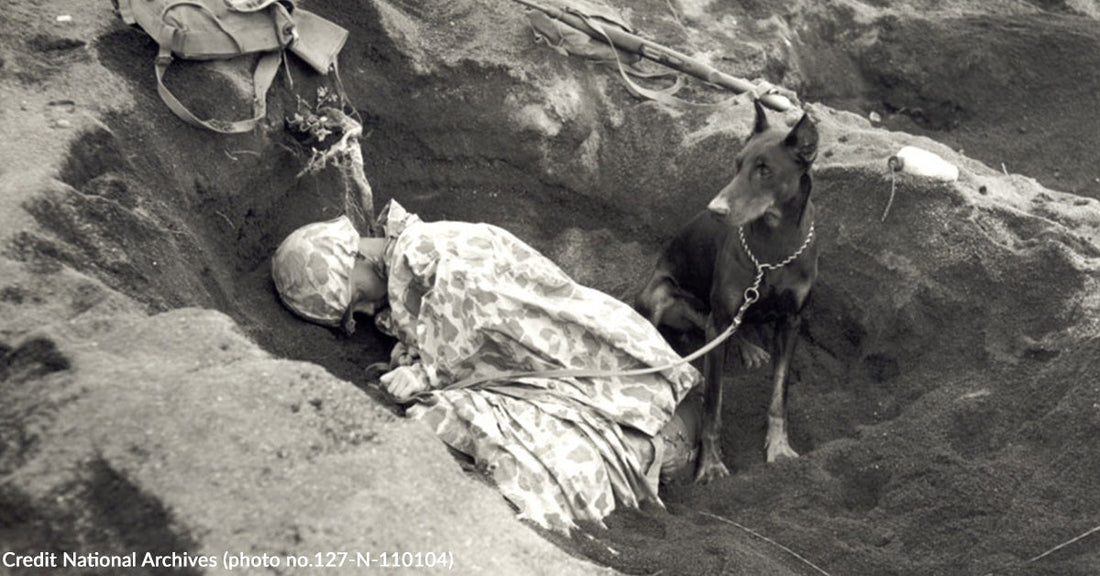
During World War II, the clash of nations was not fought by humans alone. Alongside infantry, sailors, and pilots, thousands of animals took on roles that were at once practical and deeply emotional. The National Archives’ exhibit “Buddies: Soldiers and Animals in World War II” shines a moving light on these often overlooked participants. Through historical photographs and careful curation, it reveals how war dogs, pack mules, horses, and even small mascots became workers, warriors, comrades, and sources of comfort in a global conflict.
The exhibit, first opened in 1993 as part of the National Archives’ commemoration of the fiftieth anniversary of World War II, began with a simple but powerful premise. Government photographers documented nearly every aspect of the war, and their cameras lingered not only on military strategy and battle scenes but also on the bonds that formed between soldiers and animals. Today, hundreds of such images reside in the National Archives and Records Administration’s Still Picture Branch in College Park, Maryland, preserving a visual record of these unusual partnerships.
“Buddies: Soldiers and Animals in World War II” collects thirty-six of those photographs into a focused narrative. The curator, Lisa B. Auel, assembled images that show animals at work and at rest, in moments of intensity and moments of quiet. The result is an exhibit that has traveled to museums around the United States, inviting visitors to reconsider what it meant to serve on the front lines. It is not solely a story of human courage. It is also a story of shared labor and shared hardship between soldiers and the animals that stood beside them.

Historically, military forces around the world relied on animals long before the twentieth century. Armies used horses, elephants, and camels to carry troops and supplies. Pigeons transported critical messages across enemy lines. Dogs helped track adversaries and guarded vulnerable positions. The article notes that these contributions often altered the course of battles and shaped the fortunes of individual combatants. In World War II, U.S. forces continued this practice, adapting time-honored roles to modern warfare.
On the battlefields of World War II, horses, mules, and dogs played especially prominent roles as workers and warriors. Horses still carried soldiers on patrol in Europe and into combat in places like the Philippines. Even as mechanized vehicles grew more common, there were landscapes and missions where an animal’s sure-footedness and endurance were irreplaceable. Mules, trained in the United States and dispatched overseas by the thousands, served as tireless pack animals. Their loads included food, ammunition, weapons, and at times the soldiers themselves. They moved across rough terrain where trucks and jeeps could not go, their strength directly supporting entire infantry units.

Tec 4 S. Medeiroa, of the Army's 26th Division, holds the unit's mascot, Little Joe. Ottweiler, Germany. March 21, 1945. National Archives photo no.111-SC-202435
War dogs became some of the most versatile and valued animal allies. According to the article, around twenty thousand dogs served in the U.S. Army, Coast Guard, and Marine Corps. Their duties were as varied as the conditions of the war itself. Some guarded critical posts and depots, protecting supplies in vulnerable locations. Others carried messages when radio silence was necessary or when equipment failed. Certain dogs took on lifesaving roles, such as locating and aiding downed pilots.
Perhaps most striking were the responsibilities of scout dogs. Moving at the front of patrols, these animals helped lead soldiers through enemy territory. Their senses often detected danger, from hidden enemy positions to possible ambushes, before human scouts could see it. The article emphasizes that in such roles, dogs repeatedly demonstrated intelligence, courage, and loyalty under fire. Photographs preserved by the National Archives document not only their service but also their sacrifice.
Yet “Buddies” is not only a record of animals performing military tasks. It is also a testament to the emotional connections that formed between people and animals in wartime. Many U.S. military units adopted animal mascots. While sometimes spoken of as good luck charms, these mascots were essentially shared pets. They belonged to an entire squad, company, or ship, and their presence provided a sense of continuity amid constant upheaval.

Marine Cpl. Edward Burckhardt found this kitten at the base of Mount Suribachi, Iwo Jima, the scene of some of the most brutal fighting of the war. February 1945. National Archives photo no.80-G-304862
Individual service members often kept their own pets as well. A few soldiers, sailors, or marines quietly smuggled animals from home, but most found companions among local animals left homeless by the fighting. Dogs, cats, birds, and other creatures that might otherwise have struggled to survive became part of military life. For the animals, being taken in by a unit meant food, shelter, and relative safety. For the soldiers, the companionship of a pet softened the harshness of war.
These relationships are at the heart of the exhibit’s emotional impact. The photographs selected for “Buddies: Soldiers and Animals in World War II” show off-duty moments in which soldiers are playing with a dog, sharing a meal with a unit mascot, or resting with a cat curled nearby. Such images do not trivialize the conflict. Instead, they highlight small acts of kindness and care that persisted even in the most brutal circumstances. I found this detail striking, because it shows how the need for connection and comfort can find expression in the simple act of caring for another living being.

Dogs are inducted into the Army at Front Royal, Virginia. August 25, 1942. National Archives photo no.111-SC-140929
The exhibit also underscores how these relationships were mutually sustaining. The article notes that for individual soldiers, a pet meant companionship on the battlefield. These animals could provide familiarity when everything else felt foreign and uncertain. They offered a nonjudgmental presence and a reminder of life beyond the war. At the same time, for many animals whose homes or owners had been lost, life with a unit meant survival and a measure of stability.
As a curated story drawn from archival images, “Buddies: Soldiers and Animals in World War II” invites contemporary audiences to think about the war from a more nuanced perspective. It does not replace stories of strategy, sacrifice, or human heroism. Instead, it adds another dimension, revealing how animals helped carry burdens, guard lives, and sustain spirits. The partnership between soldiers and animals did not end with the war, but the photographs from this period capture a particularly intense and poignant chapter in that long history.
Curator Lisa B. Auel, who worked on the National Archives and Records Administration Exhibits Branch staff, designed the exhibit to commemorate both the service of animals and the bonds they formed with humans. In doing so, she helped ensure that these “buddies” would not be forgotten. Their presence in the historical record quietly reminds us that in times of profound crisis, cooperation and care often extend beyond the boundaries of our own species. Read more at https://www.archives.gov/publications/prologue/1996/fall/buddies.html