
The Surprising Reason Animals Evolved to Have Necks
Guest Contributor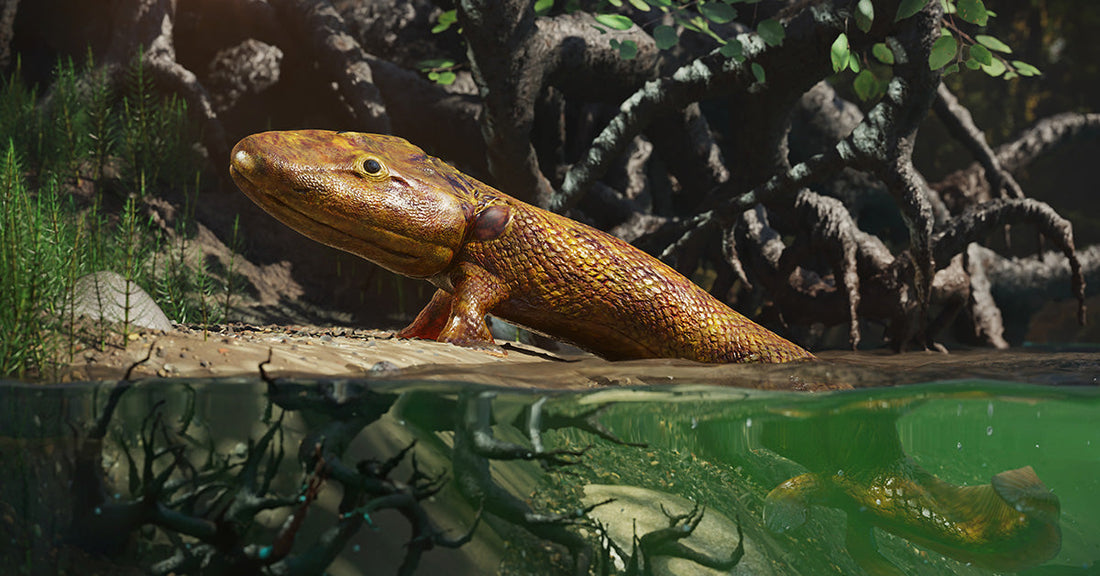
For years, schoolbook diagrams and popular science illustrations have told a simple story about the evolution of necks. As ancient fish ventured from water to land, they supposedly evolved flexible necks so they could turn their heads, look around, and better spot prey or danger. New research from an international team of scientists now argues that this familiar story is incomplete. According to their work on early tetrapod neck mobility, the first necks were surprisingly stiff and may have evolved to help animals walk with their front limbs rather than to help them look around.
The study focuses on a pivotal moment in Earth’s history, close to 380 million years ago, when some fish-like creatures began exploring shallow waters and eventually the land. This was a time when early forests were taking root and ecosystems were reshaping. Understanding how vertebrates crossed that boundary from water to land has long fascinated scientists, partly because many of the anatomical innovations from that period are still written into the human body today. The appearance of a distinct neck is one of those innovations.

For decades, the dominant explanation for neck evolution centered on head mobility. Aquatic fish generally lack a separate neck because their shoulder structures are fused closely to their skulls. To look in a different direction, they typically pivot their entire body. It felt intuitive that once animals began navigating shallow water or soft ground, a flexible neck would be a handy upgrade. Being able to tilt or rotate the head without moving the whole body would make it easier to track prey, assess threats, and scan new surroundings on land.
That reasoning guided many interpretations of key transitional fossils. Tiktaalik, discovered on Ellesmere Island in the Canadian Arctic and first described in 2006, became a star example. It displays an intriguing mix of fish traits and tetrapod features, including stronger, more limb-like fins and a clear separation between the head and shoulder girdle. Because Tiktaalik is closely related to the earliest vertebrates with true limbs, researchers long assumed that its distinct neck allowed its head to move freely. This fit neatly with the idea that neck mobility was a major evolutionary driver as vertebrates adapted to life on land.
Yet there has always been a complication. Much of the backbone structure in these early tetrapod relatives was made of soft tissue, which fossilizes poorly. Bones preserve well, but soft structures in the vertebral column rarely survive for hundreds of millions of years. That gap in the fossil record left uncertainty about how flexible those early necks really were. If the vertebral column itself limited movement, the separation of head and shoulders might not have translated into the freedom of motion scientists had imagined.
This is where modern sturgeon entered the story. Sturgeon are often referred to as living fossils because they retain several ancient anatomical traits. In particular, their vertebral columns prominently feature a notochord, a flexible rod-like structure that runs along the spine. Early tetrapods also had backbones built around a substantial notochord surrounded by relatively small vertebral elements. Since this type of backbone is rare in living vertebrates today, sturgeon provided a valuable living analogue.
The research team measured the mechanical properties of the notochord in sturgeon, including how stiff it is and how it responds to bending. They then integrated those measurements into models of fossil animals such as Tiktaalik and other early tetrapods. By combining actual biomechanical data from a living species with detailed reconstructions of fossil anatomy, they could estimate how much the neck region in these ancient creatures could realistically move.
The results were striking. The models showed that even when the skull and shoulders were clearly separated in the skeleton, the backbone’s structure would have severely restricted head motion. Early tetrapod necks appear to have been much less flexible than previously assumed. In many cases, these animals could not elevate their heads more than typical modern fish. Side-to-side twisting of the head, such as the motion involved in shaking the head “no,” was not mechanically feasible in any of the modeled early tetrapods.
The researchers also note that their estimates are likely generous. Their calculations focused on the mechanics of the vertebral column itself. In life, other tissues would have further limited movement. Muscles, connective tissue, skin, and in some cases bones embedded within the skin would all add constraints. Taken together, this suggests that the first distinct necks were even stiffer than the models indicate.

These findings challenge the long-held assumption that necks first evolved to improve head mobility. Instead, they point toward a different explanation tied to locomotion. As some fish-like animals began using their front fins or proto-limbs to support their bodies and push against the substrate, the skeletal layout needed to shift. The shoulder girdle had to be reconfigured so that the front limbs could bear weight and provide propulsion. Separating the head from this changing shoulder region may have been a necessary side effect of adapting the forelimbs for movement.
In this view, the earliest necks were part of a broader skeletal reorganization driven primarily by how these animals moved, not how they looked around. The ability to freely swivel the head appears to have been a later refinement. Once the basic neck structure existed, future evolutionary changes could gradually loosen the constraints on movement. Eventually, more flexible necks became a significant advantage on land, allowing animals to track targets, communicate visually, and interact with complex environments in ways that rigid-bodied fish could not.
I found this reinterpretation especially striking because it shows how an anatomical feature we often consider in isolation can be deeply tied to other systems. The neck is not just a pivot for the head. In these early tetrapods it was part of a mechanical chain involving the spine, shoulders, and front limbs. The study also highlights the importance of the notochord, a structure that is central in early development for many vertebrates yet receives less attention when we think about adult anatomy. For much of vertebrate history, notochord-dominated backbones were widespread, and understanding their biomechanics is essential for reconstructing how ancient animals moved.
The research underscores how combining fossil evidence, living analogues, and biomechanical modeling can reshape seemingly settled evolutionary narratives. Fossils provide the anatomical roadmap, living species like sturgeon supply crucial mechanical data, and digital models bridge the two. Together, they reveal that the first necks were not the agile, head-turning structures many had imagined, but relatively rigid components of a body still in the midst of figuring out how to walk.
By carefully testing assumptions about early tetrapod neck mobility, this work adds a nuanced chapter to the story of vertebrate evolution. It reminds us that key innovations such as limbs, necks, and new feeding strategies often evolve together, interacting in complex ways. The neck that now lets humans nod, turn, and look around with ease appears to have begun as a stiff, constrained structure that quietly supported a more fundamental shift: the move from swimming to walking. Read more at https://www.sciencedaily.com/releases/2026/11/261108233101.htm