
Homeowners Wake Up to Tawny Owls on Chandelier and Curtains
Guest Contributor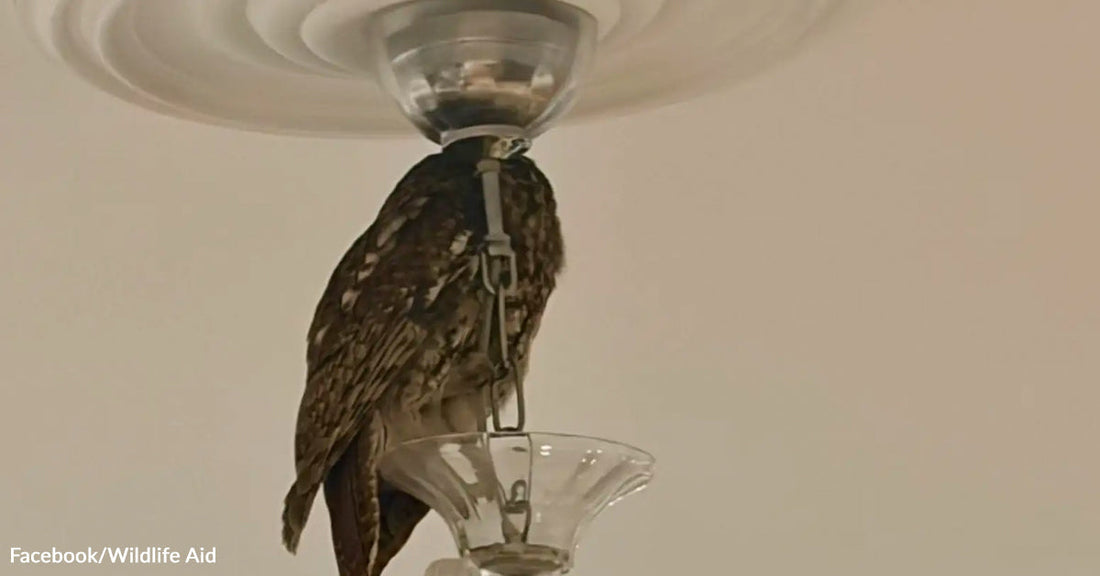
Some homeowners wake up to the sound of birds singing outside. One couple in the United Kingdom, according to Wildlife Aid, woke up to something far more surprising and a little surreal: a wild tawny owl perched sleepily on their chandelier and another hanging upside down from their curtains. As odd as it sounds, this unexpected indoor visit turned into a heartwarming story of wildlife rescue, recovery, and an almost storybook return to the wild. It is the kind of uplifting animal rescue story that feels made for sharing.
According to Wildlife Aid’s account, the drama began quietly in the middle of the night. While the couple slept, two tawny owls apparently dropped down their chimney and landed in the dining room. By the time the homeowners came downstairs the next morning, the birds had made themselves startlingly visible. One owl chose the chandelier as a makeshift roost, calmly snoozing among the light fixtures, while the other clung upside down to the curtains like a feathered acrobat. Wildlife Aid later described the scene on Facebook, noting that the pair did not seem in any rush to leave on their own.

The homeowners, stunned by the sight of two wild birds in such an ornate and unusual setting, quickly realized they needed help. Tawny owls are powerful, sensitive animals, and trying to remove them without proper training could risk injury both to the humans and to the birds. The couple reached out to Wildlife Aid, a charity experienced in dealing with distressed animals. Rescuers arrived soon after, prepared for the challenge of coaxing not just one but two stressed owls safely out of the house.
Wildlife Aid noted that rescuing a single owl indoors can already be complicated. There are reflective surfaces, narrow spaces, and plenty of hazards for a panicked bird. With two owls in the mix, the margin for error shrinks. The team had to work carefully so they did not frighten the birds into crashing into walls or windows. Details of the exact handling process were not elaborated in the account, but Wildlife Aid reported that their rescuers knew just how to remove the owls without causing further harm. Soon enough, both birds were secured and transported out of the unusual dining room setting that had briefly become their nighttime roost.

Once the pair were safely in hand, Wildlife Aid transported them straight to a wildlife hospital. This was where veterinary staff could examine them closely and understand what had happened inside that chimney. The organization later shared that the vets discovered superficial scratches to both owls’ eyes. Wildlife Aid suggested these injuries were likely caused by the birds’ fall down the chimney, a cramped and potentially abrasive descent for any animal with broad wings and sensitive eyes.
Fortunately, the injuries were not severe. The scratches were described as superficial, which meant the owls had a strong chance of full recovery with proper treatment. At the hospital, the birds received care tailored to their eye injuries, as well as a quiet, controlled environment to rest and recuperate from what must have been a highly stressful ordeal. Wildlife Aid emphasized that they were placed under the dedicated supervision of the team, whose experience with wild patients helps smooth the transition from trauma to healing.
The two tawny owls were soon identified as a male and female pair, and Wildlife Aid staff gave them names to match their soot-filled adventure. The birds became known as Sooty and Sweep, a playful nod that captured the light-hearted side of an incident that could have gone badly if the birds had been more seriously hurt or if rescue help had been delayed. Once settled into their enclosure, Sooty and Sweep finally had the chance to enjoy uninterrupted rest, this time without chandeliers, curtains, or startled humans nearby.
Wildlife Aid later shared that Sooty and Sweep adapted well to their temporary new surroundings. In the days after their rescue, the primary concern remained their injured eyes. Tawny owls rely heavily on their vision to navigate at night, locate prey, and avoid obstacles, so the health of their eyes is essential for survival after release. The organization reported that the damage to both birds’ left eyes had improved significantly with treatment and monitoring. This encouraging update meant that the pair was drawing very close to being fit for release back into the wild.
The plan for Sooty and Sweep’s release was already taking shape just a few days after their arrival at the hospital. Wildlife Aid expressed excitement at the prospect of returning them to their natural woodland habitat as soon as the veterinary team confirmed they were fully ready. I found this detail striking because it reflects a guiding principle of responsible wildlife care: the goal is not to keep animals in captivity longer than needed, but to restore them to their own environment once they can thrive independently.
As Wildlife Aid shared updates on social media, many followers seemed captivated by the image of two wild owls turning a chandelier and curtain rail into temporary forest branches. The organization mentioned that the devoted online community was just as eager to see the pair return home as the original homeowners who discovered them. Wildlife Aid also encouraged people to look at additional photographs of the rescue and recovery process, giving animal lovers a chance to see Sooty and Sweep’s journey from confused houseguests to nearly ready-for-release raptors.
Beyond the unusual setting, the episode highlights how important local wildlife charities and rehabilitation centers are when unexpected encounters with wild animals occur. The homeowners recognized that they were not equipped to handle two distressed owls on their own and instead called in professionals. That decision likely made the crucial difference between a chaotic scene and a safe, controlled rescue. It also ensured that Sooty and Sweep received prompt medical attention for their eye injuries, which in turn made their rapid recovery possible.
As the story stands now, Sooty and Sweep are approaching the final chapter of their brief time in human care. Wildlife Aid has said that they are very nearly ready to return to the wild, and the team has expressed eagerness to share news once the release has taken place. For the homeowners, it will probably be a tale they tell for years: the morning they walked into their dining room and found one tawny owl napping on a chandelier and another hanging from the curtains. For everyone following along, it is a vivid reminder that even the most ordinary spaces can become the backdrop for an unforgettable moment when people and wildlife cross paths, and that with the right help those moments can end with animals safely soaring back into the world where they belong.