
Famous 9/11 Photo Captured Ladder 118 Racing Toward the Disaster That Would Claim Every Man Aboard
Guest Contributor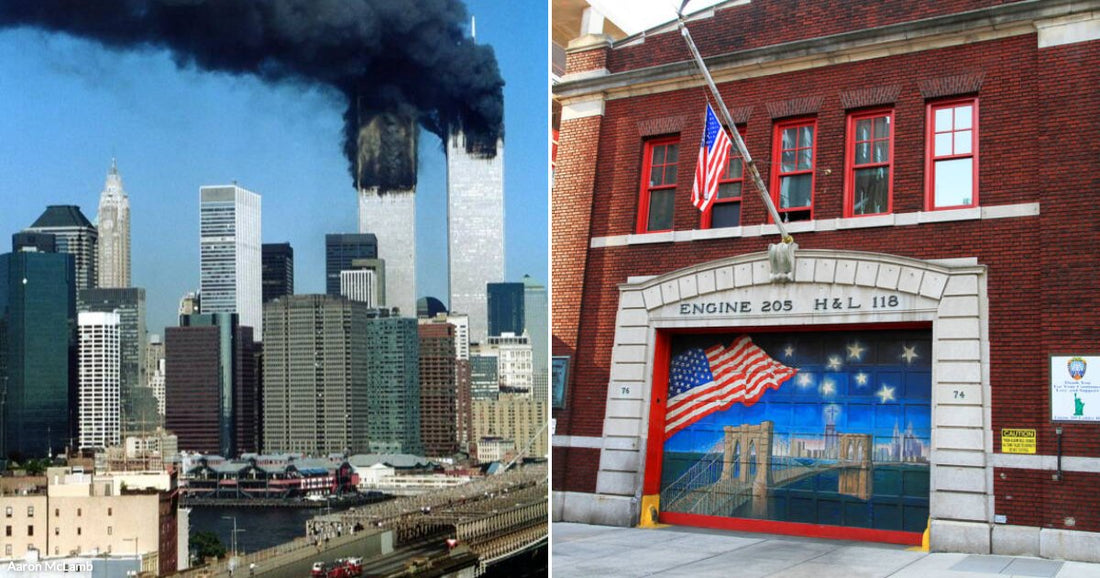
On the morning of September 11, 2001, as smoke began to pour from the World Trade Center, an amateur photographer named Aaron McLamb stepped to a 10th floor window near the Brooklyn Bridge and lifted his camera. What he captured in that instant has since become one of the most haunting 9/11 images: the bright red Ladder 118 fire truck racing across the Brooklyn Bridge toward the Twin Towers, framed by the rising plumes of smoke. No one looking at that photo in real time could have known that it showed a doomed fire truck on its last run, or that every firefighter aboard was heading toward a sacrifice that would help define American heroism.
McLamb had arrived at work just before the first plane struck the North Tower. Eighteen minutes later, he watched in disbelief as the second plane hit the South Tower. From his vantage point high above the street, the chaos unfolding below felt eerily muted. He later recalled the surreal stillness: he could not hear the crackling fires or the wounded buildings, only the piercing sirens of fire trucks rushing over the bridge. It was in that quiet, disorienting moment that he raised his camera and preserved a scene that would come to symbolize both courage and loss on September 11.

Aaron McLamb/New York Daily News
At the Middagh Street firehouse in Brooklyn Heights, the firefighters of Ladder 118 had started that Tuesday like any other shift. Once the second plane struck, the alarms sounded and there was little time to think. Six men climbed aboard Ladder 118 and pulled out toward Manhattan. They were veterans, fathers, pioneers, and friends, united by a shared commitment to rush toward danger when others were trying to get away.
Vernon Cherry, 49, had nearly three decades of service with the FDNY and was planning to retire at the end of the year. He was one of the relatively few Black firefighters in New York at the time, and coworkers knew him not only as a seasoned professional but also as a gifted singer. Leon Smith, another Black firefighter on the crew, belonged to the Vulcan Society, an organization for Black firefighters. He had joined the FDNY in 1982, driven by a desire to help people, and had spent nearly two decades answering that call.

Wikimedia Commons
Joseph “Joey” Agnello was approaching his 36th birthday and was a proud father of two young sons. Like so many firefighters, he balanced a dangerous job with a family life that meant everything to him. Lt. Robert “Bobby” Regan had taken a different path to the firehouse. Trained as a civil engineer, he chose to become a firefighter after his daughter was born, seeking a career that allowed for more time with his family while still serving his city.
Another member of the crew, Pete Vega, brought the experience of a military veteran. He had served six years in the U.S. Air Force and participated in Desert Storm before his honorable discharge. Vega joined the FDNY in 1995 and, by 2001, had just completed a B.A. in Liberal Arts from the City College of New York. Scott Davidson, who had started his firefighting career only a year before Vega, was remembered for his humor, kindness, and love of Christmas. He is also known today as the father of Saturday Night Live performer Pete Davidson, who was only seven years old when his father died.
As Ladder 118 roared onto the Brooklyn Bridge, McLamb watched from his window. He had grown up dreaming of being a firefighter and often visited the Middagh Street firehouse just to admire the trucks. On that morning, he found himself waiting for a familiar rig to appear through the smoke. When he saw it, he told a colleague, “Here comes the 118,” then pressed the shutter at the exact moment the truck sped past, its red paint catching the light against a darkening sky. The resulting photograph, later shared widely as an iconic 9/11 fire truck image, would come to stand for the countless first responders who drove toward the disaster without hesitating.
After crossing the bridge into Manhattan, Ladder 118 headed to the Marriott World Trade Center hotel, which stood in the shadow of the Twin Towers. The six firefighters ran inside and climbed the stairs, guiding frightened guests down through the smoke and confusion. People who survived that day remembered their calm under pressure and the way they stayed until as many people as possible were safe.
A hotel mechanic, Bobby Graff, later recalled that the Ladder 118 crew seemed fully aware of the danger, yet refused to abandon their posts. He believed they saved hundreds of lives, including his own. In total, more than 900 guests were rescued from the hotel. When the Twin Towers eventually collapsed, the Marriott came down with them. Buried in the rubble were hundreds of firefighters, including all six members of the Ladder 118 team.
Months later, recovery crews found the bodies of five of the six men from Ladder 118. Some were discovered lying only a few feet apart, as if they had faced the final moments together just as they had answered the call together. Agnello, Vega, and Cherry were later buried in adjacent plots at Brooklyn’s Green-Wood Cemetery, a decision that reflected their final resting place as well as their bond in life. Agnello’s wife explained that they were found side by side and should stay side by side.
A week after the attacks, McLamb walked back into the Middagh Street firehouse carrying a stack of developed photographs from that day. The firefighters who remained recognized their own truck and the familiar outline of Ladder 118 crossing the Brooklyn Bridge. One retired firefighter, John Sorrentino, later said that realizing the image showed their rig sent chills down his spine. McLamb eventually gave the photograph to the New York Daily News, which ran it on the front page. It soon joined other well-known 9/11 photos that captured the grief, bravery, and patriotism of that September morning.
For many, that picture needs no caption. Sorrentino reflected that while people say a picture is worth a thousand words, no words seem adequate for this one. It is a snapshot of a split second, yet it holds an entire story: a city under attack, a fire truck racing toward danger, and six men who would not return. I found it striking that a single frame can convey both the urgency of the response and the silence of what those firefighters did not yet know.
In the years since, the survivors and colleagues of Ladder 118 have worked to keep the memory of the six men alive. Inside the Middagh Street firehouse, the duty board has been left exactly as it was on the morning of September 11, the names of Cherry, Smith, Agnello, Regan, Vega, and Davidson still written in chalk beside their assignments. Their portraits hang on the wall, joined by photos of two other firefighters from the same house, Robert Wallace and Martin Egan, who were also killed that day. Pete Davidson carries his father’s memory in a different way, with a tattoo of Scott Davidson’s badge number, 8418.
The story behind the Ladder 118 September 11 photo is not just about an image that went viral or a fire truck crossing a bridge. It is about individuals who lived full lives, loved their families, and chose a profession that called on them to face danger with resolve. Their legacy lives on in the people they saved, in the firehouse traditions preserved in their honor, and in the way that one photograph continues to remind viewers of the human cost of that day. As Sorrentino put it, what happened will never be forgotten, and those men will never be forgotten. Those who knew them, and those who have come to know them through stories and images, will not let that happen.
Read more at https://allthatsinteresting.com/ladder-118-september-11-photo