
Haunting 9/11 Photos Capture the Horror, Courage and Human Cost of America’s Darkest Day
Guest Contributor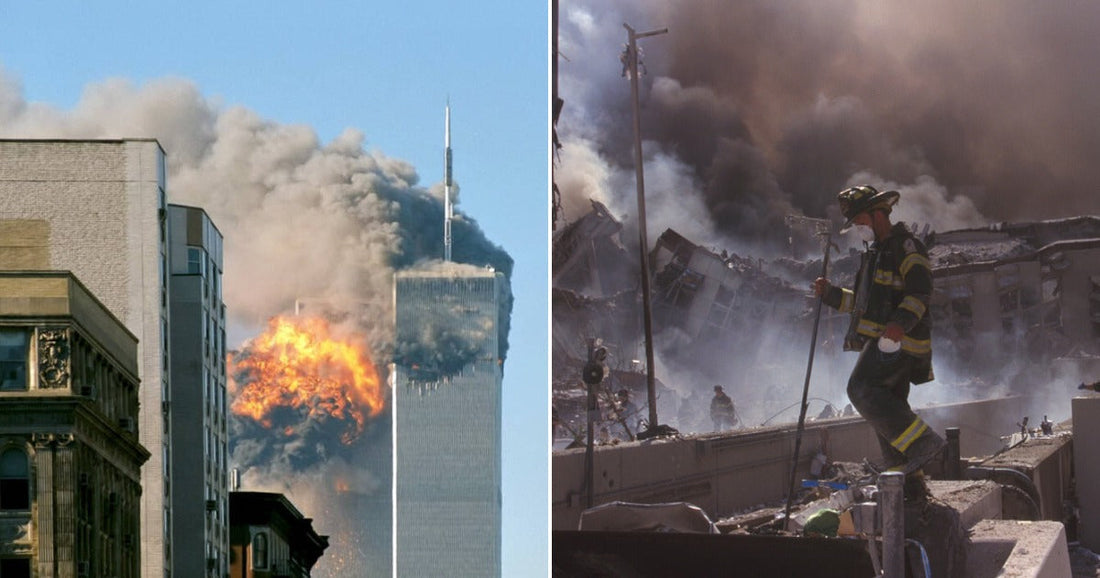
Looking back at the most powerful 9/11 pictures is a stark reminder of how much happened in a span of minutes and how long the impact has lasted. These photographs of September 11, 2001 capture the shock on the streets of New York, the devastation at the World Trade Center and the Pentagon, and the courage of people who suddenly found themselves at the center of history.
The day began as a clear late summer morning. At 8:46 a.m., American Airlines Flight 11, hijacked by five Al Qaeda operatives, crashed into the North Tower of the World Trade Center. At first, many people did not grasp what they were seeing. The content describes New Yorkers standing in the streets, staring up in disbelief as smoke poured out of the building. Television crews, photographers, and bystanders all pointed their cameras toward the North Tower, unsure if it was a tragic accident or something else.

Seventeen minutes later, that uncertainty vanished. At 9:03 a.m., United Airlines Flight 175, also hijacked and traveling from Boston to Los Angeles, struck the South Tower on live television. The images of the impact are some of the most searing 9/11 photos in the collection. Flames burst from the building, debris rained down, and crowds below gasped, cried, or simply froze. In a matter of seconds, it became clear that New York City was under attack, even as the identity and motives of the attackers remained unknown.
Photographers on the ground captured small, personal moments inside this enormous event. One image shows New York Daily News photographer David Handschuh being carried to safety after his leg was shattered by falling debris. Other photos show people covered in ash, their clothes and hair turned gray as they fled the collapsing towers. Some simply knelt or sat on the pavement, overwhelmed by what they had just seen unfold above them.

The photographs also preserve the faces of those who rushed toward danger. Firefighters from the New York Fire Department appear again and again in the gallery, walking into smoke-filled streets or calling for more rescue workers to join them at the ruins of the towers. One picture shows a firefighter emerging alone from a haze of dust and ash, the outline of his gear barely visible. Another shows retired Fire Chief Joseph Curry shouting orders as crews pick through the debris that was once the World Trade Center.
Some of the most difficult images are those of people trapped in the towers who chose to jump rather than face spreading flames and intense heat. The article notes that these victims made an impossible decision in their final moments. Photographs of falling figures are painful to look at, yet they form part of the historical record and underline the horror inside the burning buildings.

Beyond New York, the chaos extended to Washington, D.C. and rural Pennsylvania. At 9:37 a.m., American Airlines Flight 77 crashed into the Pentagon, killing all 64 people on the plane and 125 people inside the building. Photos show smoke billowing from a gaping hole in the Pentagon’s southwestern side, and officials surveying the damage the next day. Meanwhile, United Airlines Flight 93 crashed into a field near Shanksville, Pennsylvania after passengers fought back against the hijackers and prevented the plane from reaching its likely target in Washington. The gallery includes a reference to the heroism of Mark Bingham and the other passengers who resisted.
Back in New York, events moved with shocking speed. At 9:59 a.m., less than an hour after being struck, the South Tower collapsed in about 10 seconds. Eyewitness footage shows the building giving way from top to bottom as a massive cloud of dust, ash, and debris races through lower Manhattan. At 10:28 a.m., the North Tower fell as well. A later collapse, that of World Trade Center Tower 7 at 5:21 p.m., was attributed to intense fires that caused the structure to fail. Photographs taken from Brooklyn and New Jersey show the changing shape of the skyline as the towers first burned, then disappeared into plumes of gray.
Search and rescue efforts began almost immediately. The article highlights more than just human responders. Nearly 100 search and rescue dogs worked the piles at Ground Zero, their handlers guiding them over unstable rubble as they searched for both survivors and victims. One photo shows a German Shepherd navigating twisted metal and broken concrete. Another image captures Trakr, a famous search dog, alongside handler James Symington at the site in September 2001.

Amid the ruins, individual stories emerged. According to the article, 27 hours after the attacks, Genelle Guzman-McMillan became the last survivor to be pulled alive from the rubble. The toxic dust and debris that filled the air would go on to cause serious long-term health problems for many survivors, residents, and responders. The content notes elevated rates of cancer, reduced lung function, and illnesses in more than 18,000 New York City residents linked to the contamination that settled over lower Manhattan.
Leadership images appear alongside those of responders and civilians. The piece recounts how President George W. Bush learned of the attacks while visiting an elementary school in Sarasota, Florida. That night, he addressed the nation and declared that the government would make no distinction between terrorists and those who harbored them. In the days that followed, he stood near the wreckage at Ground Zero and spoke through a bullhorn, telling workers that the people who knocked the buildings down would soon hear from the United States. These moments, frozen in photographs, signaled the beginning of what became known as the War on Terror.

The economic impact of September 11 is staggering. The article cites estimates of more than 3 trillion dollars in total costs. The World Trade Center complex alone suffered an estimated 60 billion dollars in damage. In the first month after the attacks, losses were estimated at 123 billion dollars. Congress approved a 40 billion dollar anti-terrorism package within days. Cleanup at Ground Zero took until May 30, 2002. Removing 1.8 million tons of debris required 3.1 million hours of labor and cost around 750 million dollars.
The attacks reshaped daily life in quieter ways as well. For three days following September 11, no civilian flights were allowed to enter or leave United States airspace. When the skies closed, 38 planes had to divert to Gander Airport in Newfoundland. The stock market remained shut until September 17. One photo in the collection shows a man in New York holding a sign with his blood type as he waits in line to donate blood, an example of how many people tried to help in any way they could.
Across the gallery, the human cost of the deadliest terror attack in history is never far from view. Nearly 2,753 people died in New York, a total that rose to 2,977 when deaths at the Pentagon and in Pennsylvania are included. Among them were 343 firefighters, 72 law enforcement officers, and 55 military personnel. Photos show exhausted rescue workers resting beside overturned cars, firefighters breaking down in tears at the base of twisted steel, and family members searching for loved ones who worked in the towers.
Some objects became symbols of survival and memory. The Koenig Sphere, a sculpture that had stood at the center of the World Trade Center plaza for almost 30 years, survived the destruction and appears in the gallery scarred but standing. Another widely shared image shows the Statue of Liberty with the burning towers in the background, a stark pairing of American iconography and sudden catastrophe. A NASA photograph captures the smoke plume from space, while United States Geological Survey imagery maps its spread over the city.
The article closes by noting that even decades later, victims continue to be identified and families continue to receive long-awaited, and often heartbreaking, confirmations. It mentions a 2021 study that estimates around 900,000 people have died in post 9/11 wars, including combatants, civilians, journalists, and aid workers killed as a direct result of conflicts that followed. One quote reflects on the “9/11 generation” of service members and volunteers, describing them as among the greatest the nation has produced and reminding readers that this generation was born on that day.
Looking at these 9/11 images together, it becomes easier to grasp what numbers alone cannot convey. They show terror, confusion, and grief, but they also show people helping one another, running toward danger, or simply standing still as they tried to understand a world that had suddenly changed. For anyone revisiting September 11, 2001 through photographs, this collection offers a difficult yet important window into America’s darkest day and the lives forever altered in those 102 minutes and their long aftermath.