
🚨Urgent: Rush Aid to People & Pets in Nepal's Devastating Floods! Help Now!
Tiny Dog Found In Crate That Had Been Abandoned In The Sun For Hours
Guest Contributor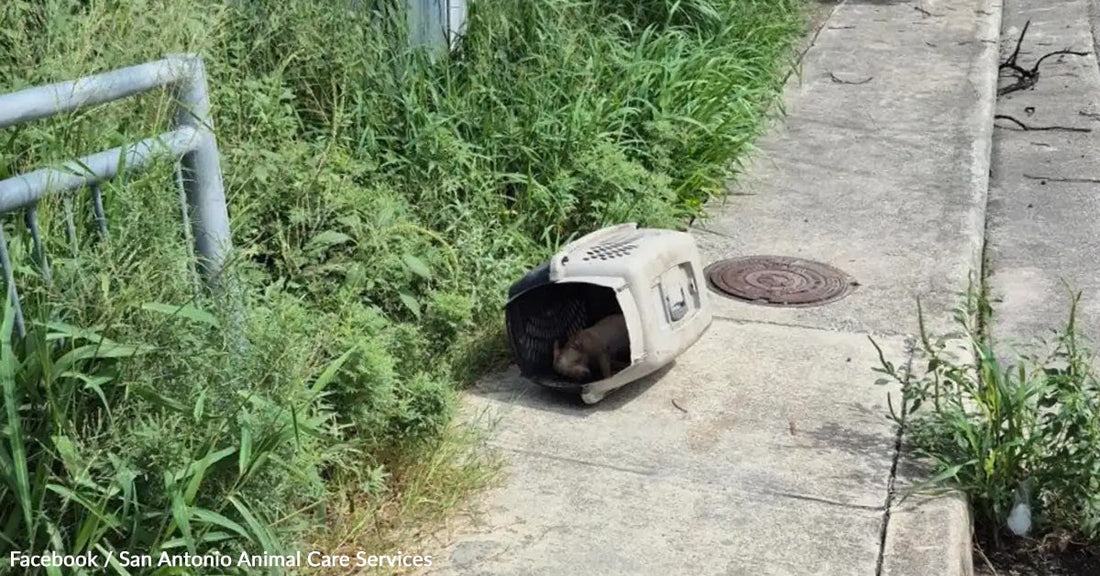
In the sweltering Texas heat, a plastic crate sat unnoticed on a sidewalk near a dry creek bed in San Antonio. Covered in dirt and missing its door, the crate blended into the background of a busy street where cars passed without pause. But when someone finally looked inside, they found a heartbreaking sight: a small dog, still and silent, lying on the hard plastic floor. This moment marked the beginning of a journey from abandonment to hope for a dog who would come to be known as Arroyo.

The story, as reported by San Antonio Animal Care Services (SAACS), began when an anonymous caller alerted the city’s animal welfare agency to the presence of the crate and the animal inside. Officer Garza responded to the call and found the dog, later named Leo, barely responsive. According to Lisa Norwood, public relations manager at SAACS, Leo was so weak that he didn’t lift his head. His body was infested with ticks and fleas, and he seemed too exhausted to move.
Officer Garza approached with caution. As he reached into the crate, Leo retreated to the back, trying to make himself as small as possible. Norwood shared that their first assumption was that Leo might have been struck by a car, given his immobility and clear distress. Using the crate as a makeshift stretcher, Officer Garza transported the dog to SAACS' medical facility, where air conditioning and medical attention awaited.
Once inside the cool truck, Leo slowly began to show signs of life. He lifted his head, a small but significant gesture that hinted at his will to survive. At the facility, staff treated him for parasites, administered vaccinations, and offered him wet food. Though slightly underweight at just 14 pounds, Leo had no major injuries. However, his emotional wounds were evident. He remained withdrawn, refusing food and flinching at human contact.
“He wouldn’t move, other than if somebody was trying to put their hands into the crate,” Norwood said. “Then he would cower.” These behaviors suggested a history of neglect or abuse. The dog’s fear was palpable, and it was clear that he had endured more than just physical discomfort. I found this detail striking: even in a safe environment, Leo’s instinct was to hide. It’s a reminder of how deeply trauma can shape an animal’s behavior.
Fortunately, Leo’s story took a hopeful turn when SAACS reached out to one of their rescue partners, SNIPSA. The organization, known for helping abandoned and at-risk animals, took Leo into their care and renamed him Arroyo — a nod to the dry creek bed where he was found. The name symbolized not only his origin but also the start of a new chapter.
SNIPSA quickly placed Arroyo in a foster home, where he received the comfort and care he had long been denied. In this nurturing environment, Arroyo began to open up. He now sleeps on a soft bed with a blanket, surrounded by toys. He enjoys the cool air conditioning and has started to accept food directly from his foster’s hand. These small milestones represent a significant shift from the fearful dog Officer Garza first encountered.
Norwood noted that Arroyo’s transformation was swift. “They’re like, ‘Okay, we’re going to get you this new life, buddy. You’re going to have a new name,’” she recalled of SNIPSA’s approach. The rescue group’s commitment to giving Arroyo a second chance was evident in every step of his recovery. In just a few days, the dog who once cowered in silence began to show signs of trust and curiosity.
Now estimated to be around five years old, Arroyo is no longer defined by the crate he was found in. He’s learning to trust, to play, and to accept love. An interested adopter has already begun the process to welcome him into a permanent home, signaling a bright future for the once-forgotten pup.
For those moved by Arroyo’s journey, organizations like SNIPSA and SAACS provide a vital safety net for animals in need. Their work ensures that discarded pets aren’t left to suffer in silence. Arroyo’s story is a powerful reminder of the resilience of animals and the difference that compassion can make.