
🚨Urgent: Missile Strikes Shelter in Ukraine! Rush Emergency Aid!
Rick Wakeman Plays Piano for 150 Rescued Moon Bears Who Spent Years Chained Inside Bile Farms
Guest Contributor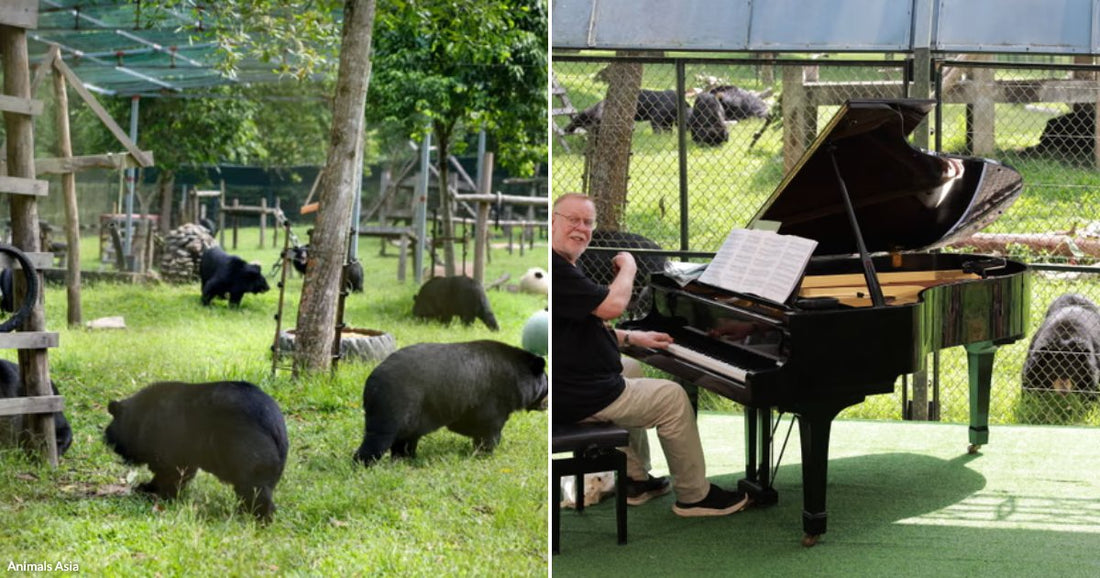
If you wandered into Vietnam’s Tam Dao national park recently, you might have caught one of the most unusual concerts in rock history: prog legend Rick Wakeman playing gentle piano music to an audience of rescued bears. The image alone is unforgettable, and it anchors a story that is at once heartbreaking and hopeful. At a sanctuary that now protects around 150 bears saved from the bear bile trade, Wakeman rolled out his Yamaha piano and offered what can only be described as a healing performance for animals that have endured years of cruelty.
The context makes this musical moment far more than a charming novelty. For years, bears in Vietnam were kept in cramped cages, often chained and immobilized while their bile was extracted for use in traditional Chinese medicine. According to the report, that practice has now been banned in Vietnam, yet the country is still one of the largest markets in the illegal wildlife trade in East Asia. Against that backdrop, Wakeman’s visit and performance take on a quiet gravity. The article highlights how these bears have survived a “truly horrific life” and are only now beginning to experience comfort, safety, and enrichment.

Animals Asia
Wakeman has long been known not only as a virtuoso keyboardist but also as a committed supporter of animal welfare. The piece notes that he has rescue cats and dogs of his own, which makes his performance at the bear sanctuary feel like a natural extension of a lifelong concern for animals. Setting up outside the sanctuary enclosure, surrounded by forest and protected habitats, he selected music tailored for this very specific audience. He explained in an interview that animals often respond to “gentle melodic music,” so he chose pieces that were soft and lyrical, hoping the bears would be drawn closer to listen.
That hope, as the article describes, was fulfilled. In video footage from the event, some of the bears can be seen approaching the perimeter of the sanctuary as Wakeman plays. They sniff the air, move closer, and then appear to settle in. The description notes bears nodding their heads and finding a comfortable perch to sit and listen. It is a quiet, almost surreal scene, but also a reminder that rescued animals can experience curiosity, calm, and even what looks like appreciation when they are given the chance to live in peace.

Animals Asia
The performance was organized by Animals Asia, the organization that runs the Tam Dao sanctuary. The sanctuary currently cares for around 150 bears. These animals are no longer confined to cages but instead live in secure enclosures where they can roam, play, and interact. Animals Asia’s CEO, Dr Jill Robinson, expressed deep gratitude for Wakeman’s support. She described how his affection for the bears can be heard in the “beautifully haunting” music that he composed and played for them. Her comments underscore that this was not simply a publicity event. It was designed as both a gesture of respect toward the bears and a call for greater action.
Wakeman’s visit was not just about the concert; it was also about advocacy. The article reports that he used the occasion to urge the Vietnamese government to increase its efforts to help the bears that are still trapped in former bear bile farms. While 150 bears are now safe within the sanctuary, approximately 125 more remain in cages elsewhere, with four reportedly dying each month. Wakeman framed this as an urgent situation. The message was simple and clear: these remaining animals need to be moved into sanctuary care as quickly as possible if they are to survive and recover.

Animals Asia
Descriptions of the bears’ behavior at the sanctuary make the urgency of that call even more vivid. Wakeman spoke about how the animals seem “almost human” in the way they look at visitors, suggesting a depth of expression and presence that stays with those who meet them. According to his account, the bears are not tame, yet they are safe and visibly happier. They play, romp, and engage with their environment. One image in particular stands out from the article: he observed two bears jumping into a bubble bath and playing together, a scene that would have been unthinkable during their years in captivity. I found this detail striking because it illustrates in a simple way what rehabilitation looks like when animals are finally given the freedom to behave naturally.
The story calls attention to the broader effort to end the bear bile trade and to transform compassion into concrete change. Sanctuaries like the one in Tam Dao are at the heart of this shift. They provide veterinary care, nutritious food, space to move, and opportunities for mental stimulation. At the same time, they function as powerful educational spaces where the public can learn about wildlife welfare, the impacts of illegal trade, and the importance of long term support. A celebrated musician sitting at a piano in front of a forest enclosure can reach audiences who might never otherwise hear about the plight of bile farm bears, making the cause more visible and relatable.
The article also highlights how music itself can play an unexpected role in animal welfare. Wakeman’s belief that animals respond to melodic sounds is supported in this case by the bears’ visible curiosity. While science is still exploring exactly how animals perceive and interpret music, there is growing interest in ways that sound can be used to enrich captive or recovering wildlife. In this instance, gentle piano pieces functioned as both enrichment for the bears and a symbolic offering of kindness after years of suffering. Even for human observers, there is something deeply affecting about the juxtaposition of intricate piano lines drifting across a sanctuary where animals are reclaiming their lives.
In the end, the image of Rick Wakeman playing to bears in a Vietnamese forest resonates for several reasons. It brings attention to the ongoing work of organizations like Animals Asia, it underlines the urgency of rescuing the remaining caged bears, and it suggests that creative acts of solidarity can have real impact. For readers learning about the Tam Dao sanctuary for the first time, the story offers a rare blend of sadness over what these animals endured and cautious optimism about what is now possible. The bears that gathered near the fence to listen to piano music are living proof that, with care and commitment, lives can be transformed and futures rewritten. Read more at https://www.yahoo.com