
Scarred Remnants of 9/11 Still Stand at Ground Zero While Thousands Walk Past Without Knowing Their Story
Guest Contributor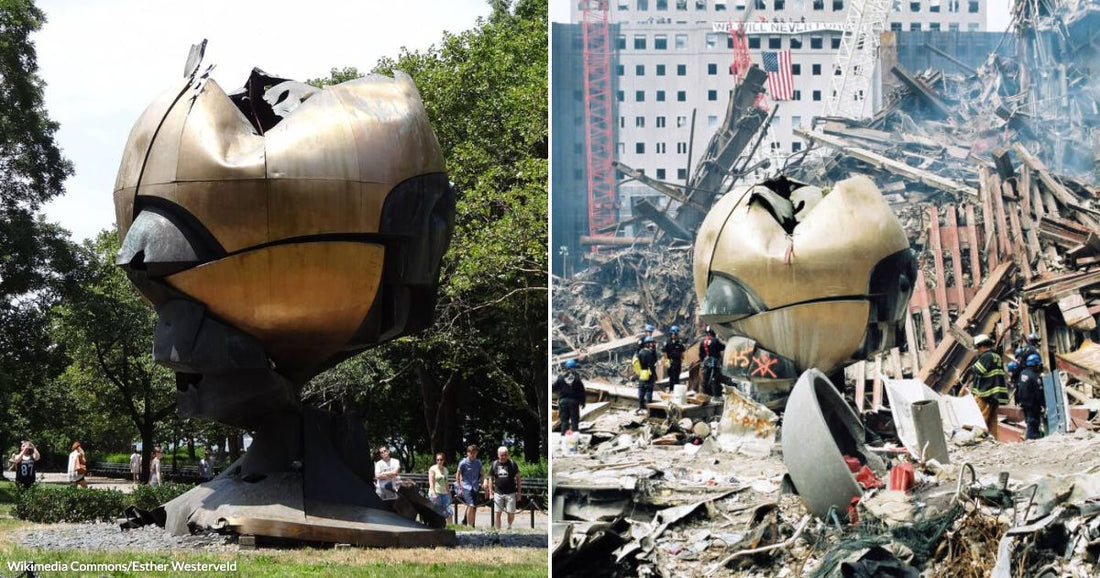
Most visitors who make their way to Lower Manhattan for a 9/11 memorial visit head straight to the twin reflection pools and the museum below ground. These are the anchors of public memory, the places where people expect to feel the weight of history. Yet just steps away from the main 9/11 Memorial are quieter, easily overlooked remnants of the attacks. They sit in plain sight, part of the everyday cityscape of office workers and tourists. The story of the Koenig Sphere and the Liberty Street pedestrian bridge offers a powerful reminder that the history of September 11 lives not only in formal exhibits, but also in the scars and survivors woven into New York’s streets.
In a video that has drawn hundreds of thousands of views, content creator Carolina, who describes herself as a “September 11th history enthusiast,” highlights two specific artifacts that many people unknowingly pass by. Her focus is not on the well-documented exhibits behind museum glass, but on objects that still occupy the public realm. These remnants of 9/11 stand where daily life continues all around them, asking only a second look from those who walk by.

FEMA News Photo/Bri Rodriguez
The first is the monumental Koenig Sphere. Before September 11, 2001, this 45,000 pound bronze sculpture was the centerpiece of the World Trade Center Plaza for nearly three decades. It stood between the Twin Towers as part of the complex’s public space, a large abstract form that commuters and visitors moved around without necessarily knowing its name. After the towers collapsed, the Sphere was found battered but still recognizable amid the ruins.
Rescuers and workers removed the damaged sculpture from the site and brought it to John F. Kennedy International Airport for storage. There it waited while the city grappled with loss, cleanup and rebuilding. In March 2002, a team of ten ironworkers, six engineers and its artist, Fritz Koenig, set about the intricate task of reassembling it in Battery Park. The Tribeca Trib later described the artist as “nervously pacing” as the team worked around the clock to piece together the warped and torn bronze.

Esther Westerveld
The Sphere was rededicated on March 11, 2002, exactly six months after the attacks. For Koenig, the sculpture had been profoundly altered, not only physically but in meaning. He told the Tribeca Trib that people now knew the piece more than before, explaining that it was no longer just a sculpture because it carried “bad history.” The form that once simply decorated a plaza had become an object bound to grief, survival and memory.
Years later, in 2016, the Port Authority announced that the Koenig Sphere would return to the World Trade Center area. Koenig told CNN he was glad to hear that the Sphere was coming back to the place it had been made for, “deeply destroyed and surviving at least.” For some families who lost loved ones on 9/11, that return had particular resonance. Michael Burke, whose brother was a firefighter killed that day, said that if the location was good enough for the artist, it was good enough for him.

Since 2017, the Koenig Sphere has stood in Liberty Park next to the memorial site. Importantly, it has been left in its damaged state. Its ripped metal, dents and missing sections are not hidden or repaired. Carolina notes in her video that she finds that choice both fascinating and powerful. The scarred sculpture bears visible evidence of what it survived, serving as a physical survivor from the original plaza that once connected the Twin Towers.
The Sphere is not the only such remnant in the neighborhood. Across West Street, another artifact carries the marks of that morning in a quieter way. The Liberty Street pedestrian bridge stretches over the traffic, linking the World Trade Center area with Brookfield Place. To most people it looks like a typical covered skywalk. Yet for those who know where to look, its aluminum panels still show the impact of the collapse.
Carolina points out that if visitors look carefully at the Liberty Street bridge, they can still see dents, dings, holes and gashes in the metal siding. The New York Times reported that these marks most likely date from the collapse of the South Tower on 9/11. Many people who cross the bridge every day never notice them at all. For others, recognizing their origin creates a strong emotional connection. Architectural historian Christopher Gray told the Times that he always loved looking at those holes, a reminder that everyday infrastructure can carry deep historical meaning.
By 2016, the bridge was due for a broader reconstruction. The damaged panels were slated for replacement as part of that work. Rather than quietly discard them, Brookfield Property Partners coordinated with the National September 11 Memorial Museum and the New York Fire Department to preserve at least some of these pieces. The panels, while not as visually prominent as artifacts in the main memorial, still carry traces of that morning’s violence in their twisted surfaces.
Jan Seidler Ramirez, chief curator of the 9/11 Memorial Museum, told the Times that the institution would be honored to have such materials if they could be saved. She emphasized that it was crucial to show the public that the attacks did not only destroy the seven buildings of the World Trade Center complex, but also damaged the surrounding urban fabric. The Fire Department also considered displaying some of the panels either in the New York City Fire Museum or in firehouses as memorial objects.
For Ramirez, the lingering damage told its own story. Speaking in 2016, nearly fifteen years after the attacks, she noted that the city was still slowly repairing the physical consequences of a single morning. That observation underscores how tragedy can leave marks that remain long after the cameras have gone and construction cranes have moved in. Even as Lower Manhattan has been rebuilt and reimagined, certain scars persist as part of the landscape.
These lesser-known artifacts around Ground Zero illustrate how memory can take different forms. The official 9/11 Memorial and Museum invite deliberate reflection, with carefully curated exhibits and solemn design. Nearby, the Koenig Sphere and the wounded panels of the Liberty Street bridge offer something more understated. They survive in the flow of everyday life, where office workers hurry past and tourists look for directions. They ask nothing from passersby except attention.
For those who seek out traces of the past in the present-day city, sites like these can be especially meaningful. A sculpture once seen as a simple plaza centerpiece has become a survivor, its damaged skin a permanent record of impact and endurance. A skywalk that might otherwise fade into the background reveals itself as a quiet witness, its pitted metal a reminder that catastrophe brushed against far more than the towers alone. In pointing to these remnants, voices like Carolina’s invite others to look more closely at the urban environment, to recognize that history often lives in the details we are most likely to overlook.