
Crews Sink the Legendary SS United States Off Florida to Create the World’s Largest Artificial Reef
Guest Contributor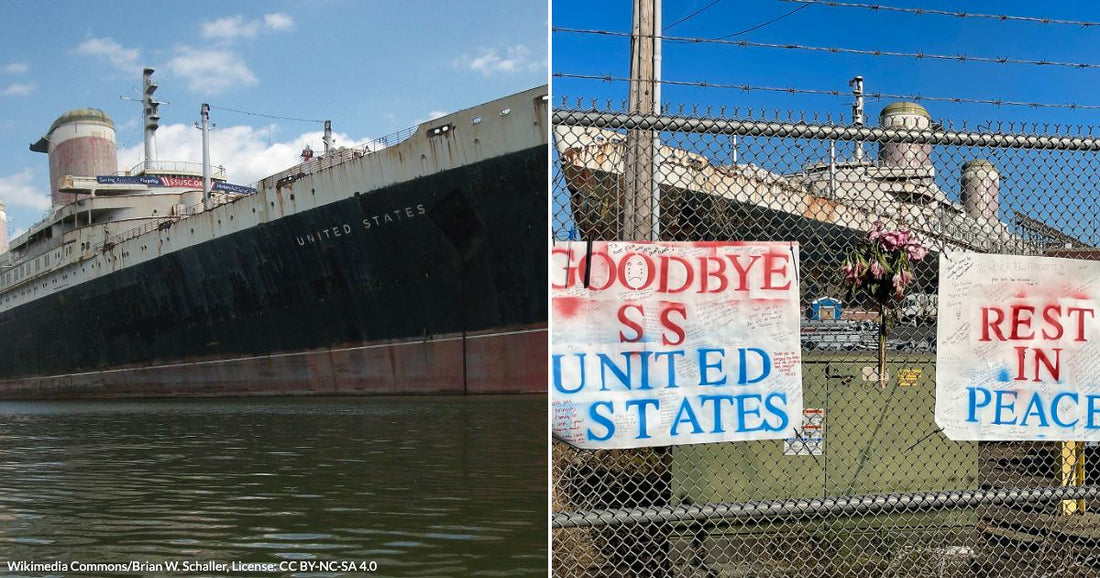
The SS United States once represented the height of American ambition at sea. Launched in 1952, this nearly 1,000-foot ocean liner held the title of the fastest passenger ship in the world and set a transatlantic speed record on its maiden voyage. Now, after decades away from open water, the iconic vessel has taken on a new role as the world’s largest artificial reef off the coast of Destin, Florida. This transformation from record-setting liner to underwater habitat marks a poignant turning point in its long story, blending maritime history with marine conservation.
The ship’s journey to the ocean floor began on a Wednesday afternoon in the Gulf of Mexico, where crews prepared the SS United States for its final deployment. The vessel had been carefully hollowed out, and openings were cut into its hull to control the way water would enter and guide it into a stable position on the seafloor. Around 2.40pm ET, deployment operations started. Shortly before 5pm, the sinking process began in earnest as the Gulf’s waters slowly filled the interior of the vast steel structure.

Over several hours, the SS United States gradually settled into the water, a deliberate descent that was closely managed to help it land upright. By around 10pm, the former ocean liner had finally reached the bottom at a depth of roughly 180 feet. Its upper decks now sit about 55 feet below the surface. In its new resting place, the ship is expected to become a major diving destination, drawing visitors from around the world who are interested in both historic shipwrecks and thriving artificial reef sites.
For much of its service life, the SS United States was known as a symbol of postwar innovation and luxury at sea. Over 17 years of operation, it carried thousands of passengers across the Atlantic, partnering speed with elegance on routes that connected the United States to Europe. After being retired in 1969, the vessel did not immediately find a clear second purpose. Instead, it entered a long period of uncertainty that played out mostly at a pier rather than at sea.

For years, the ship remained docked in Philadelphia. Ownership changed hands more than once as different groups explored ways to save and restore the historic liner. The SS United States Conservancy, a non-profit organization, became one of the main advocates for preservation. They faced a difficult reality, however. Maintaining such a large, aging vessel in port proved enormously expensive. By 2021, the situation had become especially strained when port authorities raised the daily dockage fee to 1,700 dollars. This cost was beyond what the conservancy could sustain, and long-term restoration concepts became harder to imagine.
The eventual solution arrived from an unexpected direction. In 2024, Okaloosa County in Florida purchased the SS United States for 1 million dollars with a bold new vision. Rather than restoring the liner as a floating attraction or a hotel, county officials planned to sink it in the Gulf of Mexico as the world’s largest artificial reef. This approach sought to honor the vessel’s significance while also providing measurable environmental and recreational benefits.

Artificial reefs are typically designed to create new habitats in areas where natural reef structure is limited. Large, stable structures offer surfaces where corals and other organisms can attach and grow, and they create complex spaces that shelter fish and invertebrates. In this case, officials expect the SS United States to become a home for a range of marine species, including red snapper, grouper, amberjack, mackerel, and tuna. As marine life colonizes the hull and interior spaces, the ship is anticipated to turn into a vibrant underwater ecosystem.
The sinking also opens new possibilities for tourism and education. The sheer scale of the SS United States, now functioning as an artificial reef in the Gulf of Mexico, is likely to attract divers who are interested in exploring large, historically significant structures beneath the surface. With the upper decks sitting around 55 feet deep, advanced recreational divers and dive operators will have access to a unique site that combines history, engineering, and marine biology. Over time, the growth of marine life on its surfaces will visually transform the ship and create an evolving experience for returning visitors.
The human connection to the liner has never been purely technical. Before the sinking, Susan Gibbs, president and co-founder of the SS United States Conservancy, described the decision with a mix of realism and reverence. She explained that the ship “is being reefed and will remain intact and will become a vibrant and dynamic marine habitat,” and she emphasized that the plan, paired with a land-based museum and visitor experience, would honor the ship’s legacy in a meaningful way. I found this detail striking because it highlights how a single vessel can bridge past and present, functioning as both historic icon and living environment.
The story carries a deeply personal note for Gibbs. Her grandfather, naval architect William Francis Gibbs, designed the SS United States and devoted much of his life to it. She has described his connection to the ship as a kind of “full-bore obsession,” quoting his own lighthearted remark that he loved the liner “a thousand times more” than her grandmother. He reportedly marked its departures and arrivals with unwavering loyalty, seeing the ship off each time it set sail for Europe and greeting it on its return. That level of attachment underlines how ships like this can become far more than transportation. They can serve as symbols of national capability, engineering artistry, and family legacy.
For those who have followed the SS United States over the years, its final voyage may feel bittersweet. The dream of restoring it as an operational or permanently moored vessel has now given way to a future beneath the waves. Yet the decision to create the world’s largest artificial reef near Florida allows the liner to avoid quiet decay at a pier. Instead, it becomes a platform for new life, supporting fish populations and offering divers a powerful reminder of maritime history.
In this way, the SS United States continues to cross boundaries, just as it once crossed the Atlantic at record speed. Its steel hull and sweeping decks, once associated with glamorous passages and ocean travel, will now host schools of fish and colonies of marine organisms. When future divers descend through the water column above Destin and catch their first glimpse of the ship’s silhouette, they will encounter not only a legendary ocean liner but also a thriving reef that connects human stories to the living sea in a lasting and tangible way. Read more at https://www.theguardian.com/us-news/2026/nov/11/ss-united-states-sinks-florida-reef