
Starving Cat Arrives Looking Like A Walking Skeleton And Fights His Way Back To Love
Guest Contributor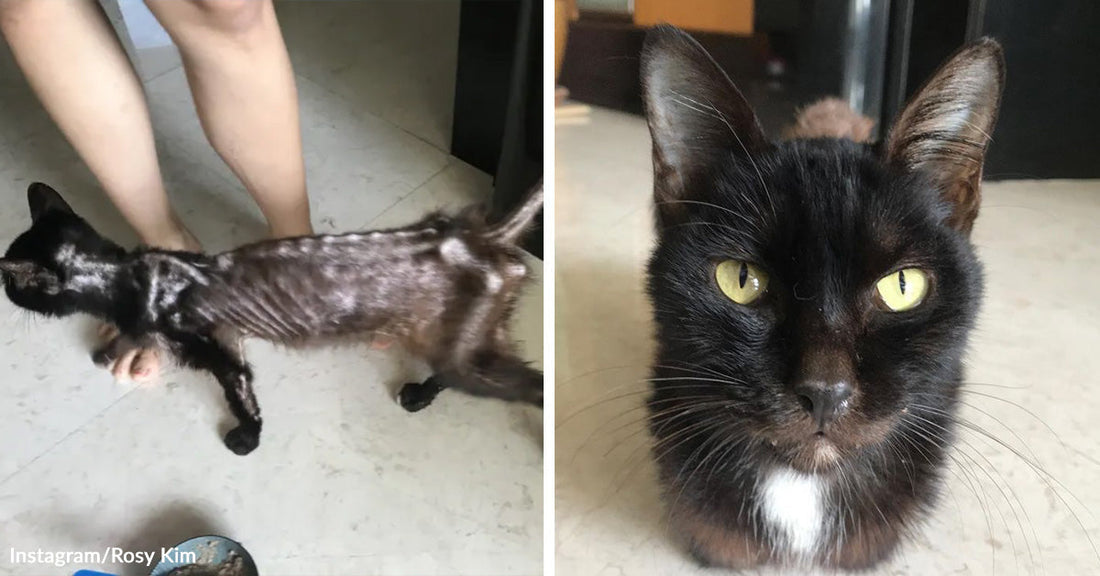
A starving “walking skeleton” cat who transformed into a healthy, affectionate companion is capturing hearts around the world. The rescue story of Khalon, a once emaciated “bag of bones,” shows how patient care, responsible vet work, and a loving home can turn near tragedy into a joyful new beginning. For anyone interested in animal rescue success stories or how to help a severely malnourished cat recover, Khalon’s journey offers both hope and insight.
Khalon first came to the attention of Allergic Rescuers KL, a rescue group based in Malaysia, when they received disturbing videos and photos of a cat who looked barely alive. His frame was so thin that every bone seemed visible. The organization’s founder, Rosy Kim, who is based in the United States, became his case worker. Kim later described him as “horrifically malnourished” and shared that at the time of his rescue he weighed only 1.8 kilograms. That weight is dangerously low for an adult cat estimated to be around three years old.

The circumstances that led to Khalon’s condition were not entirely clear. Kim and her team were not sure where he had come from or how he had been left to deteriorate so severely. Rather than dwell on incomplete details, Kim focused on what could be done next for this starving cat. She noted that in Malaysia, animal abuse and neglect are not always handled effectively, which can make accountability and prevention very challenging. In Khalon’s case, the reality was that he needed urgent, practical help more than anything else.
As soon as the rescuers secured Khalon, they rushed him to a local veterinarian, Dr. Teoh. The vet was reportedly shocked when she saw his skeletal body. To understand whether disease might be behind his extreme weight loss, she ran an array of diagnostic tests that included a complete blood count, kidney and liver function checks, electrolytes, urine concentration, and even thyroid screening. The goal was to rule out conditions that might prevent a cat from absorbing nutrients properly.
Surprisingly, the results showed that beneath the visible starvation, Khalon was relatively stable. Aside from lice and the flu, his organs were functioning within acceptable ranges. It appeared that the core of his suffering was simple and brutal: prolonged lack of food. Knowing that his body could still recover gave the rescue team and the vet a clear path forward. He needed careful refeeding, consistent medical care for his infections, and a safe environment to rest and heal.
To provide that stability, Khalon was placed with foster parents in Malaysia named Kim Louise and Craig. When he first arrived in their care in June, Louise described him on Instagram as a “sad boney cat.” Early photos showed a fragile animal with sunken sides and a haunted look, but there was also a spark in his eyes that suggested he had not given up. The foster home became the setting for his slow, deliberate transformation.
His foster parents worked with Allergic Rescuers KL and the vet to help him put on weight gradually and safely. They introduced food in measured amounts so his body could adjust after prolonged starvation, while also treating his flu. Kim later explained that the foster family did a great job “fattening him up” with time and patience, and that Khalon thrived on the affection they offered. According to her, he was loving from the very first day, eager for cuddles and gentle play despite his frail state.
As the weeks passed, Khalon’s weight began to climb. From 1.8 kilograms he reached 2.58 kilograms and eventually 3.42 kilograms. Each increase marked a milestone on his road back to health. Once he was strong enough, the team was able to proceed with his neutering, which had been delayed while he battled the flu. His improved energy levels were unmistakable. As Kim recounted, when he started feeling better, he became more playful and “a bit frisky,” another sign that his body was returning to normal.
By November, Khalon was ready for a permanent home. That is when Mike and Madeleine, a couple living in Malaysia, stepped in to adopt him. They already shared their home with a cat named Bella, whom they had brought with them from Australia, and they had been following Khalon’s journey ever since Allergic Rescuers KL first featured him on Instagram. Kim described them as warm, caring people and felt they were an ideal match for a cat who had been through so much.
When Khalon joined their family, he seemed to recognize that he had finally found security. He bonded quickly with his new parents, reportedly sleeping between them in bed as if to be as close as possible. One detail from his new life stands out in particular: he likes to jump onto Mike’s chest and carefully groom his beard, as though offering his own form of affection and comfort. I found this detail striking because it shows how a cat so gravely neglected can recover not only physically, but emotionally as well.
His personality blossomed in his new environment. Khalon flopped over for belly rubs, chased toys with enthusiasm, and embraced his reputation as an “absolute food monster.” After enduring hunger for so long, he now eats every meal as if it could be his last, a habit that feels both heartbreaking and heartwarming. While his new cat companion Bella took longer to warm up, Khalon’s easygoing nature and playful energy helped him settle into life as part of a two-cat household.
Allergic Rescuers KL later shared a tribute to his journey on their Instagram page. They expressed pride in how far he had come, reminding followers that when he was rescued at the end of June, he was literally a bag of bones. They speculated that he might have been trapped somewhere and left without food. Whatever had happened before, the focus was now on the fact that he had not only survived but found a genuine “happy ending” that also felt like a new beginning.
As images of his before and after condition spread, people online reacted with a mix of shock and gratitude. Commenters admitted they could hardly bear to look at his early photos, describing how their hearts broke at the thought of what he had endured. Many thanked the rescuers, the vet, the foster family, and his adopters for their kindness and persistence. The outpouring of compassion illustrated how a single rescued cat can inspire empathy across borders and cultures.
Kim noted that the response to Khalon’s story has been overwhelmingly warm. She described him as lovable and goofy, the kind of cat whose presence brightens the room. Today, Khalon is living what many called his best life, a stark contrast to the skeletal figure who first appeared in those disturbing videos. His recovery shows what can happen when rescue organizations, foster caregivers, veterinarians, and adopters work together around a shared goal of giving an animal a second chance. Khalon’s journey does not erase the hardship he faced, but it demonstrates that with care and commitment, even a starving cat who was once a walking skeleton can reclaim a life filled with comfort, play, and love.