
Julia Louis-Dreyfus Helps Bring a Daughter’s Alzheimer’s Story to Life in Tangles
Guest Contributor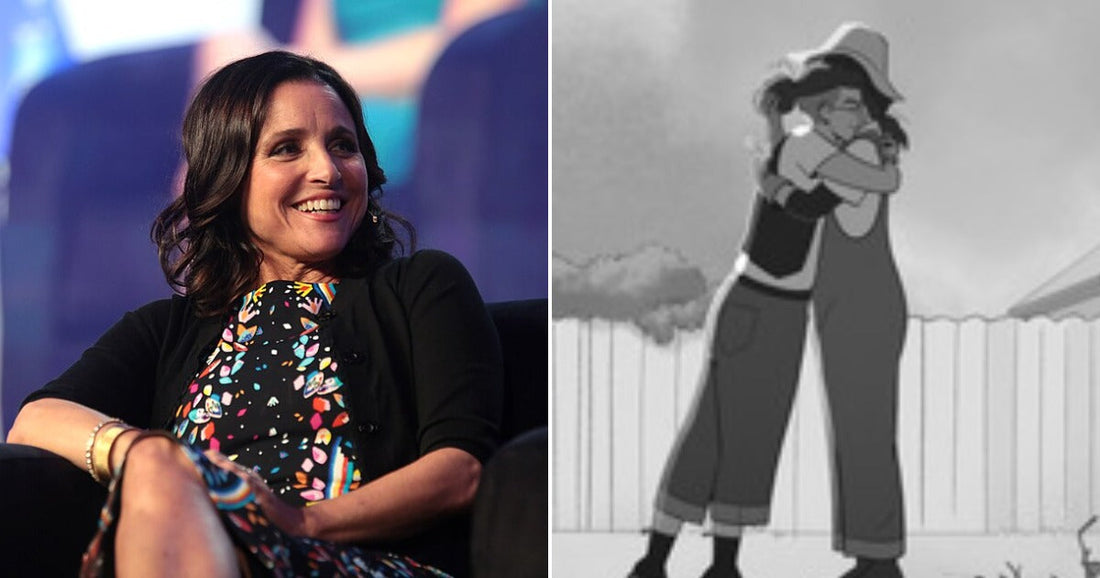
The new trailer for the hand-drawn animated feature “Tangles” offers a rare and delicate balance: it finds genuine humor in the realities of Alzheimer’s without softening the gravity of the disease. Based on Sarah Leavitt’s acclaimed graphic memoir about her mother’s early-onset Alzheimer’s, the film transforms deeply personal material into a universal story of family, caregiving, and memory. For anyone interested in powerful animation, nuanced portrayals of dementia, or memoir adaptations, “Tangles” looks poised to become a standout in the conversation.
Directed by Leah Nelson and produced by Seth Rogen and Lauren Miller Rogen, “Tangles” has already begun attracting significant attention on the festival circuit. The film just earned the Grand Jury Prize at Animation is Film 2026, a recognition that signals how strongly it resonates with audiences and juries alike. Animated mostly in stark black and white, it embraces a visual simplicity that seems to underscore the story’s emotional complexity. The trailer highlights expressive hand-drawn lines and a shifting, intimate perspective that mirrors the fragmentation and tenderness of memory itself.

Wikimedia Commons/Gage Skidmore, License: CC BY-SA 2.0
The feature adapts Leavitt’s book “Tangles: A Story About Alzheimer’s, My Mother and Me,” a graphic memoir that pieced together the author’s experiences through notes, drawings, and recollections. Nelson, working with Trev Renney and Leavitt, had to translate that nonlinear mosaic into a cohesive film narrative. She has described this as a ten-year journey, emphasizing how challenging it was to transform memories and small personal fragments into a linear script that still feels emotionally truthful. That long development period seems to have allowed the filmmakers to approach Alzheimer’s with a rare mix of clarity, patience, and care.
The story follows a family navigating the slow and relentless progression of early-onset Alzheimer’s. Rather than treating the illness as a single, defining event, the film apparently dwells on the cumulative toll it takes over time. Scenes hinted at in the trailer move between tender, difficult, and unexpectedly funny moments, reflecting how many families experience dementia in real life. The filmmakers lean into a central question: how do you keep love and humor alive as memory erodes and roles shift within a family?

“Tangles” enlists a formidable voice cast to bring these nuances to life. Abbi Jacobson and Julia Louis-Dreyfus lead the ensemble, with Bryan Cranston, Samira Wiley, Beanie Feldstein, and Seth Rogen rounding out the main roles. The casting suggests a deliberate blend of dramatic and comedic strength. Louis-Dreyfus and Rogen are both known for their ability to balance pathos and humor, while Cranston and Wiley bring dramatic gravitas that seems especially well suited to a story about caregiving, identity, and emotional strain.
The film’s visual language plays an important role in how the subject is framed. Lauren Miller Rogen has spoken about how the black-and-white animation “held the space for how complicated this disease was.” That choice does more than create an artful aesthetic. It appears to strip away distraction and color, leaving viewers face to face with expressions, gestures, and emotional beats. The effect, as glimpsed in the trailer, suggests a kind of visual honesty that matches the story’s emotional honesty, echoing the raw line work of Leavitt’s original graphic memoir.
The producers’ connection to the topic extends far beyond creative curiosity. Miller Rogen’s mother, Adele, showed the first signs of Alzheimer’s when Miller Rogen and Seth Rogen began dating more than twenty years ago and lived with the disease for sixteen years before her death. She has spoken about seeing her own story reflected in Leavitt’s memoir, particularly the early diagnosis in the mother’s fifties, her role as a teacher, and the devotion of a caregiving father. That sense of recognition helps explain why the producers approached the film with such evident personal commitment.
Seth Rogen has also articulated a guiding goal for the project: to find “humor and beauty, poignancy and resonance” in content that might otherwise be framed as purely tragic. The idea of finding humor in Alzheimer’s is delicate territory, yet Rogen’s comments suggest that the team is not laughing at the disease or its symptoms. Instead, they appear to be honoring the real moments of absurdity, irony, and laughter that arise in even the most difficult family situations. In that sense, the film may offer a more complete emotional spectrum than many traditional depictions of dementia, which often focus almost exclusively on loss.
Festival audiences have responded strongly to that approach. “Tangles” premiered in May in the Special Screenings section at Cannes, where it was nominated for the Caméra d’Or and the Queer Palm, both markers of artistic and thematic ambition. It then had its North American premiere as a Centrepiece selection at the Toronto International Film Festival, a placement that usually signals that a film is both accessible and artistically significant. The feature went on to win the Sebastiane Award at San Sebastián, further emphasizing the story’s resonance with international audiences, particularly around themes of identity and inclusion.
The film has also been part of the competition lineup at the Ottawa International Animation Festival and has now secured the top honor at Animation is Film. Taken together, these appearances suggest that “Tangles” is not just another memoir adaptation. It appears to be a film that expands what animated storytelling can do in the realm of adult, emotionally complex subject matter, standing alongside other notable works that show animation as a medium for serious, layered narratives rather than a format only for children.
Behind the scenes, “Tangles” brings together an extensive producing team. In addition to Rogen and Miller Rogen, the producers include Monarch Media’s Vicky Patel, Steve Barnett, and Alan Powell, Point Grey Pictures’ Evan Goldberg, Madeline Blair, James Weaver, and Alex McAtee, Giant Ant’s Ross Murray, Teresa Toews, and Jay Grandin, along with Jen W. Ray and Sophie Hoegh of LYLAS Pictures and Julia Louis-Dreyfus herself. That collaboration among animation specialists, independent film producers, and established performers reflects how seriously the industry is taking Leavitt’s intimate story.
With a qualifying theatrical run coming through Independent Film Company and Sapan Studio, “Tangles” is positioned to reach a broader audience beyond the festival circuit. The film’s blend of hand-drawn animation, memoir-based storytelling, and a frank yet compassionate look at Alzheimer’s places it in a unique space. It speaks not only to those who have experienced dementia within their families, but also to viewers interested in how animation can hold complex emotions: grief, love, frustration, and quiet joy. I found this intersection of form and subject especially striking, since it shows how a carefully crafted animated film can offer space to process difficult realities without losing sight of humor and hope.
As more people encounter the trailer and, soon, the full feature, “Tangles” may prompt conversations about how we talk about aging, illness, and caregiving. It invites audiences to consider how memory shapes identity and what remains when those memories begin to fray. If the early festival response is any indication, the film will not only stand as a strong Alzheimer’s story in animation, but also as an example of how personal narrative can be translated across mediums with sensitivity and creative vision.
Read more at https://www.awn.com/news/tangles-trailer-finds-humor-alzheimers