
He Ignored Every Order to Stay Put On 9/11 and Sang His People Down the Stairs to Safety Then Turned Back Around
Matthew Russell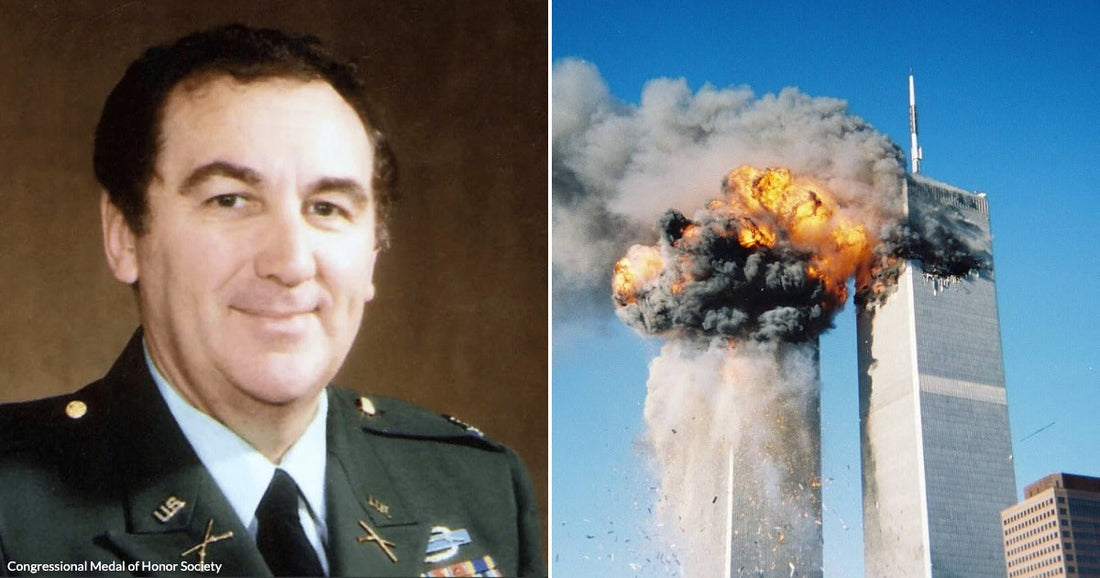
Cyril Richard "Rick" Rescorla was a man who had the habit of singing Cornish and Welsh battle hymns during moments of crisis — a habit that began in the killing fields of Southeast Asia and ended in the stairwells of lower Manhattan. But the story starts much earlier, in a small harbor town on the Cornish coast.
Rescorla was born in Hayle, Cornwall, in 1939. As a boy, he watched American soldiers stationed nearby prepare for the Normandy landings, and the image never left him, the American Presidency Project notes. He quit school at sixteen, joined the British Army, served during the Cyprus Emergency, and later worked as a paramilitary police officer in Rhodesia.
It was in Rhodesia that a friendship with an American soldier pointed him toward his destiny. He emigrated to the United States and enlisted in the U.S. Army, attending Officer Candidate School and airborne training at Fort Benning before deploying to Vietnam.

Congressional Medal of Honor Society
The Making of a Legend at Ia Drang
In November 1965, Rescorla fought as a platoon leader in the Battle of Ia Drang Valley — the first major engagement of the Vietnam War. His courage there became the stuff of military lore. Military Times reports that retired Lt. Gen. Hal Moore, who commanded troops on the ground, called him "the best combat platoon leader I ever saw."
A photograph taken by journalist Peter Arnett during the battle — Rescorla moving forward, bayonet fixed on his M-16 — became one of the iconic images of the war. It appeared on the cover of the book We Were Soldiers Once…and Young, according to HistoryNet. He earned a Silver Star, Bronze Star, and Purple Heart for his service.

National Institute of Standards and Technology
A Warning Nobody Wanted to Hear
After leaving active duty, Rescorla earned a law degree, taught criminal justice, and eventually became director of security for Morgan Stanley at the World Trade Center. He was on the job during the 1993 bombing and walked away convinced the towers would be hit again, Coffee or Die reports.
He recommended the firm relocate to New Jersey. When the lease made that impossible, he built the next best thing: a drill. Townhall reports that twice a year, Morgan Stanley employees were required to move to emergency stairwells and descend in pairs — beginning with the topmost of the company's 22 floors, each group falling in line as the one above passed. Executives grumbled. Rescorla didn't budge.

United States Army
The Morning Everything Changed
When the first plane struck the North Tower, Rescorla was at his desk on the 44th floor. The Port Authority told occupants of the South Tower to stay put. He refused. "Piss off," he reportedly told the official on the line, according to Coronado Island News. He grabbed a bullhorn and started moving people out.
The drills paid off. Employees knew exactly what to do. As they filed down the darkened stairwells, they heard Rescorla's voice — steady and singing — keeping the column moving. When the second plane tore through the South Tower and the building lurched, he stayed on the bullhorn in the pitch black, reassuring everyone around him.
During the evacuation, he phoned his wife Susan. "Stop crying," he told her, the National September 11 Memorial & Museum recounts. "I have to get these people out safely. If something should happen to me, I want you to know I've never been happier. You made my life."
Back Up the Stairs
When the last of his colleagues reached the street, a fellow director told Rescorla it was time to go. "As soon as I make sure everyone else is out," he replied, according to Drive Thru History. He turned and went back into the building.
He was last seen on the 10th floor, heading up. The South Tower collapsed shortly after. His body was never recovered. Of the more than 2,700 Morgan Stanley employees in the building that morning, All That's Interesting reports that only thirteen did not make it out.
A Legacy Carved in Bronze and Remembered in Song
Rescorla was posthumously awarded the Presidential Citizens Medal — the nation's second-highest civilian honor — with his wife Susan accepting on his behalf at a White House ceremony, UPI reports. A life-sized bronze statue, modeled after the Ia Drang photograph, stands at the National Infantry Museum's Memorial Walk of Honor at Fort Benning, Georgia.
Susan Rescorla later recalled what her husband once told her: that from a very young age, he had declared the kind of man he wanted to be, and that if he stayed on that path, he would have done the very best he could. On that September morning, he proved it.