
🚨Urgent: Missile Strikes Shelter in Ukraine! Rush Emergency Aid!
Hundreds Of Barred Owls Are About To Be Killed In This State
Matthew Russell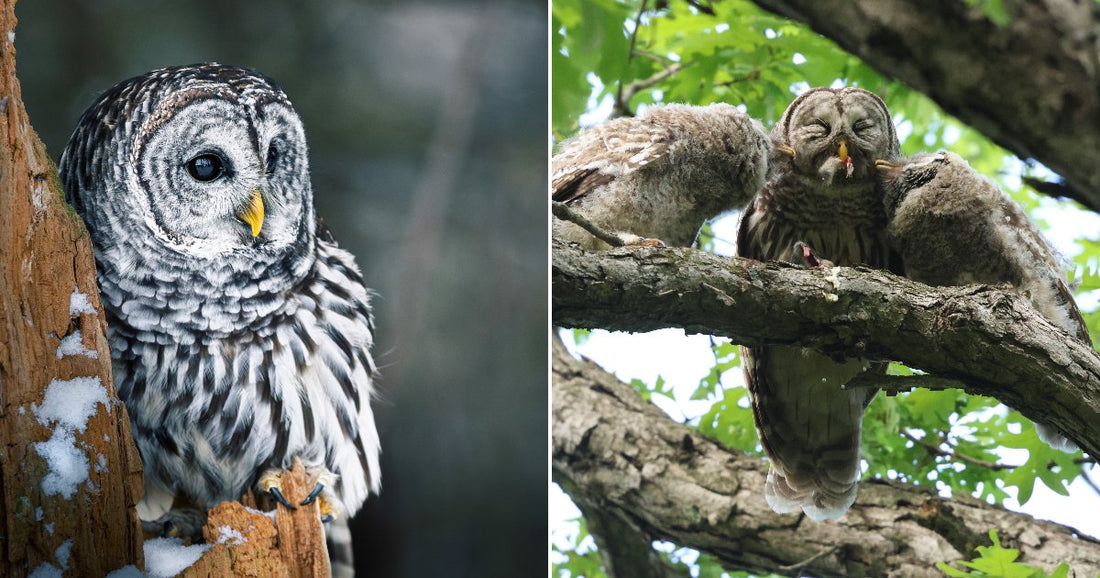
The numbers tell a stark story. Surveyors combing Oregon's Elliott State Research Forest found hundreds of barred owls living there. Jefferson Public Radio reports that only three individual northern spotted owls were detected in the most recent survey of the 83,000-acre territory.
That disparity prompted Oregon's Department of State Lands to take an extraordinary step: it hired trained contractors to begin shooting invasive barred owls inside the forest, in a bid to give the spotted owl something it has not had in years — breathing room.

Two Owls, One Impossible Choice
At a glance, the two birds are nearly twins. KLCC notes that both species share round heads, defined faces, large eyes, and dappled feathers. But the resemblance ends there.
Barred owls are bigger, faster-reproducing, and more aggressive. NBC News reports that the spotted owl population has declined by 75% over the past two decades, a collapse that accelerated as barred owls pushed deeper into Pacific Northwest forests. The spotted owl was already listed as threatened under the Endangered Species Act in 1990, and the 1994 Northwest Forest Plan protected millions of acres of old-growth habitat on its behalf — but neither measure was enough.
A new study using artificial intelligence and acoustic monitoring found that Phys.org says barred owl calls were heard eight times more often than spotted owl calls across the entire study region, and that spotted owl populations have approached or crossed functional extinction thresholds in Washington and along the Oregon Coast.

A Federal Plan With Unlikely Allies
Oregon's move is part of a much larger federal strategy. The U.S. Fish and Wildlife Service has authorized the removal of up to 470,000 barred owls across Oregon, Washington, and California over three decades, PBS NewsHour reports — a maximum of roughly 15,600 birds per year, which federal officials say would amount to less than half of one percent of the total North American barred owl population annually.
The plan drew support from an unexpected coalition. OPB reports that the Bird Alliance of Oregon reluctantly backs the program, alongside environmental groups including the Sierra Club, Earthjustice, and the Center for Biological Diversity. Oregon's two U.S. senators also support it.
The strategy was conceived under the Biden administration and put into operation under President Donald Trump — a rare patch of bipartisan ground in an otherwise fractured political landscape.

Critics, Costs, and a Lawsuit
Not everyone is convinced. Animal Wellness Action, an animal welfare organization, is suing to halt the program. Its president, Wayne Pacelle, argues the geography involved makes the plan unworkable. The Washington Times notes that critics have put the potential total cost at up to $1.35 billion, or roughly $3,000 per bird. Small groups of state and federal lawmakers have also pushed back, with some arguing that barred owls are not truly invasive but rather part of a naturally shifting ecosystem.
A University of Wisconsin team that removed more than 3,000 barred owls from California forests found that the effort stabilized local spotted owl populations and halted further barred owl establishment — lending weight to the science behind the strategy.
What Success Actually Looks Like
In the Elliott State Research Forest, wildlife managers are not expecting a population boom. Lincoln Chronicle reports that research biologist Amy Price said even a stable population would count as a win. The program there could run for at least 15 years.
The contractors carrying out the work lure barred owls using recorded territorial calls, then shoot them with shotguns. The Oregon Department of State Lands chose to follow the federal management strategy directly, citing the existing science rather than designing its own approach.
For a bird that has lost three-quarters of its population in two decades, and whose calls have gone nearly silent across entire regions of its historic range, stability — not recovery, just stability — has become the goal.