
The ID Cards Left Behind on 9/11 Put Faces to Lives Stolen
Matthew Russell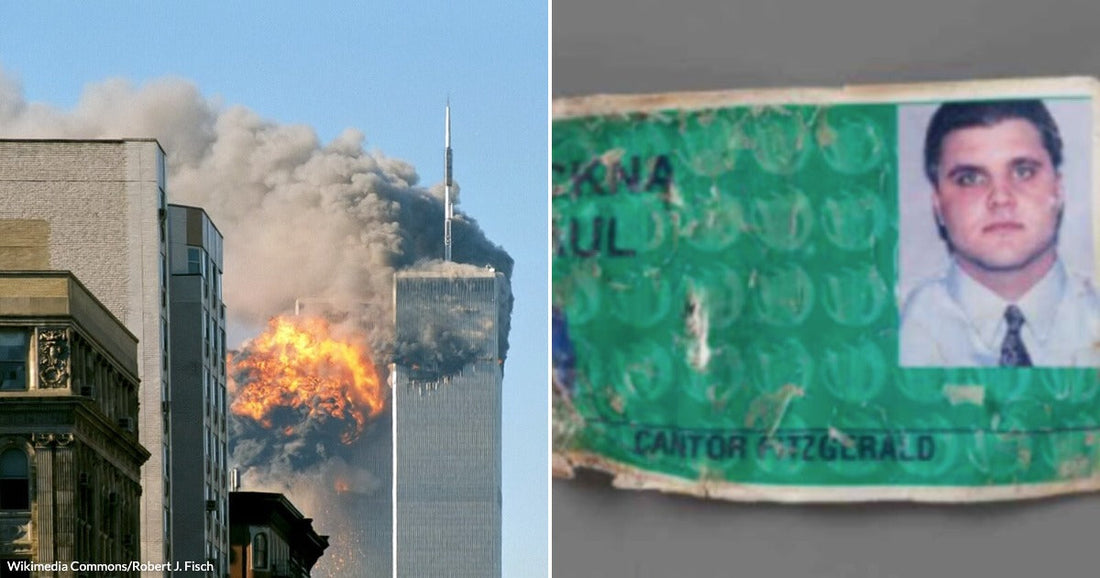
In the weeks and months after the September 11 attacks, recovery workers at Ground Zero searched for survivors, remains, and any trace of the thousands of people who had suddenly vanished. Amid the twisted steel and concrete, they began uncovering small, everyday objects that spoke volumes: wallets, keys, and, poignantly, a collection of ID cards from 9/11 victims and survivors. Now preserved at the 9/11 Memorial & Museum, these fragile pieces of plastic and paper turn a vast national tragedy into something deeply personal, revealing the human stories behind America’s worst terrorist attack.
The attacks themselves unfolded with terrifying speed. On the morning of September 11, 2001, al-Qaeda terrorists hijacked four commercial airliners and turned them into weapons directed at symbols of U.S. economic, military, and political power. American Airlines Flight 11 was flown into the North Tower of the World Trade Center at 8:46 a.m., tearing through floors 93 to 99. At 9:03 a.m., United Airlines Flight 175 struck the South Tower between the 77th and 85th floors, removing all doubt that this was deliberate, coordinated mass murder rather than some kind of accident.

9/11 Memorial & Museum
The impacts killed hundreds instantly and trapped many more people above the crash zones. Fires raged, weakening the towers’ structure. At 9:59 a.m., the South Tower collapsed in a massive cloud of dust and debris that shocked both those on the streets of Manhattan and the millions watching live on television. Less than half an hour later, at 10:28 a.m., the North Tower also came down, leaving Lower Manhattan blanketed in ash and rubble and altering the city’s skyline forever.
In total, 2,977 people were killed in the coordinated 9/11 attacks at the World Trade Center, the Pentagon, and near Shanksville, Pennsylvania. Most of those deaths occurred in and around the Twin Towers. The victims included office workers at financial and insurance firms, restaurant and maintenance staff, airline passengers and crew, and the firefighters, police officers, and medical personnel who rushed toward the burning buildings to help others escape. The destruction extended beyond the towers themselves to nearby buildings, subway lines, and streets, creating a hazardous landscape filled with toxic dust, pulverized concrete, and twisted metal.

9/11 Memorial & Museum
Within this devastation, small traces of everyday life survived. Recovery teams at Ground Zero began to find identification cards that had belonged to people who were in the towers that day. Some were scarred by fire or crushed at the edges, others remarkably intact. Taken together, these artifacts demonstrate how ordinary that Tuesday morning began and how abruptly it turned catastrophic. No one who clipped on a badge or swiped a security card on September 11 expected anything other than another day at work.
Among the ID cards now housed at the 9/11 Memorial & Museum are those of office workers, first responders, security staff, and even a shopper working at a World Trade Center market. Catherine Nardella of New Jersey, an active member of her Catholic parish, was an insurance consultant for Aon Corporation on one of the upper floors of the South Tower. Her ID represents a life of work, faith, and community that ended at age 40. Nearby in the collection is the damaged card of 26-year-old Gavkharoy Kamardinova, who had emigrated from Uzbekistan, studied in New York, and worked at an Amish Market inside the South Tower.

9/11 Memorial & Museum
Other cards recall long marriages and shared rituals. The ID of insurance underwriter Robert Gschaar is accompanied by the detail that he and his wife each carried a two dollar bill, a quiet symbol of their shared life as “two of a kind.” He had only joined Aon in July 2001 and was in his office on the 92nd floor of the South Tower when the attacks unfolded. Likewise, the identity card of Staten Island resident Paul J. Simon evokes a four-decade relationship with his wife, Shelley, that began in childhood and ended when he went to work at Marsh & McLennan in the North Tower that day.
Some of the most affecting ID cards belonged to first responders and security professionals who chose to run toward the danger. Port Authority police officer Uhuru “Gonja” Houston, who grew up in Brooklyn’s Canarsie neighborhood, helped evacuate the PATH station before turning to assist at the towers. His card stands alongside that of FDNY Captain William F. Burke Jr., a veteran firefighter known for putting his crew first. On September 11, Burke ordered the members of Engine 21 to evacuate the North Tower while he stayed behind looking for more people to rescue, a decision that cost him his life. There is also the card of William Wren, a retired FDNY member who served as the World Trade Center’s fire safety director and died helping with evacuation efforts.

9/11 Memorial & Museum
These artifacts do not only tell stories of loss. Some cards correspond to survivors who lived to see their identification recovered years later. One belongs to Joanne “JoJo” Capestro, who worked on the 87th floor of the North Tower and managed to evacuate and reach safety, though she did not make it home to Brooklyn until late in the day. Another card represents North Tower elevator passenger Christopher Briggs Young, who was trapped when the first plane hit. His elevator car abruptly stopped and he remained stuck for more than an hour. Paradoxically, the collapse of the South Tower caused a power failure that allowed him to pry open the doors and escape the North Tower only moments before it fell.
Some stories captured by these ID cards highlight friendship and loyalty in the face of impossible choices. The museum preserves the identification of Abraham Zelmanowitz, a computer programmer for Empire Blue Cross/Blue Shield who worked on the 27th floor of the North Tower. After the plane struck, Zelmanowitz refused to evacuate because his friend and coworker, Ed Beyea, was paralyzed from the neck down and could not descend the stairs without an elevator. Beyea’s own ID is also part of the collection. Both men died when the North Tower collapsed, and their intertwined artifacts now bear witness to a decision grounded in solidarity and care.
Beyond New York, the museum also holds the ID card of physician Paul Ambrose. He served as a senior clinical advisor in the Office of Disease Prevention and Health Promotion, focusing on issues such as obesity prevention, and was aboard American Airlines Flight 77 on his way to a conference in California when hijackers crashed the plane into the Pentagon. His card offers a reminder that 9/11 was a multi-site attack that touched lives far beyond Lower Manhattan.
The broader context of these artifacts is the immense effort that followed the attacks. In the immediate aftermath, vigils and memorials appeared across the United States as people confronted fear, grief, and a sudden sense of vulnerability. At Ground Zero, workers sifted through debris for approximately eight months, removing steel beams one by one, recovering remains with great care, and gradually transforming the site from a disaster zone into a place of remembrance. Many first responders, construction workers, and nearby residents would face long-term health issues linked to the dust and hazardous materials in the area, adding another layer of tragedy to an event already marked by staggering loss.
On a national level, the attacks led to sweeping policy changes. Security tightened at airports and public spaces, intelligence and counterterrorism programs expanded, and the United States created the Department of Homeland Security and passed the USA PATRIOT Act. Within a month, the U.S. launched Operation Enduring Freedom in Afghanistan with the stated aim of dismantling al-Qaeda and Taliban forces. The memory of 9/11 later influenced the 2003 invasion of Iraq and helped shape American foreign policy for years afterward.
Against this backdrop of geopolitical change and institutional response, the individual ID cards at the 9/11 Memorial & Museum serve a different, more intimate function. Displayed alongside items like jewelry, fire helmets, and pieces of bent steel, they restore names, faces, and brief biographies to people who might otherwise be remembered only as part of a statistic. The IDs of a young Polish student working a summer job in a World Trade Center cafeteria, an NYPD officer planning to retire to practice law, or a union painter from Peru who loved football and home cooking all emphasize that behind every number was a full human life.
By preserving these identification cards, the museum symbolically takes back the identities that the terrorists sought to erase. Each card is a quiet assertion that the people who died or survived that morning were more than the violence that took place around them. Their lives included families, hobbies, ambitions, faith, humor, and everyday routines. When visitors look at the worn edges of a recovered badge, it becomes easier to understand that September 11 was not only a global turning point but also a day of personal, irreplaceable loss for thousands of families.
More than two decades later, the story told by these ID cards continues to resonate. They help bridge the distance between those who remember the day vividly and those who know it only from history. In a space built on the footprints of the fallen towers, these artifacts stand as a permanent reminder that beneath the scale of the 9/11 attacks and the transformations that followed, the most important story remains the same: the lives of the people who were there, and the loved ones who carry their memory forward.