
The Dogs of 9/11 Searched Ground Zero for Survivors Until Their Paws Were Raw
Matthew Russell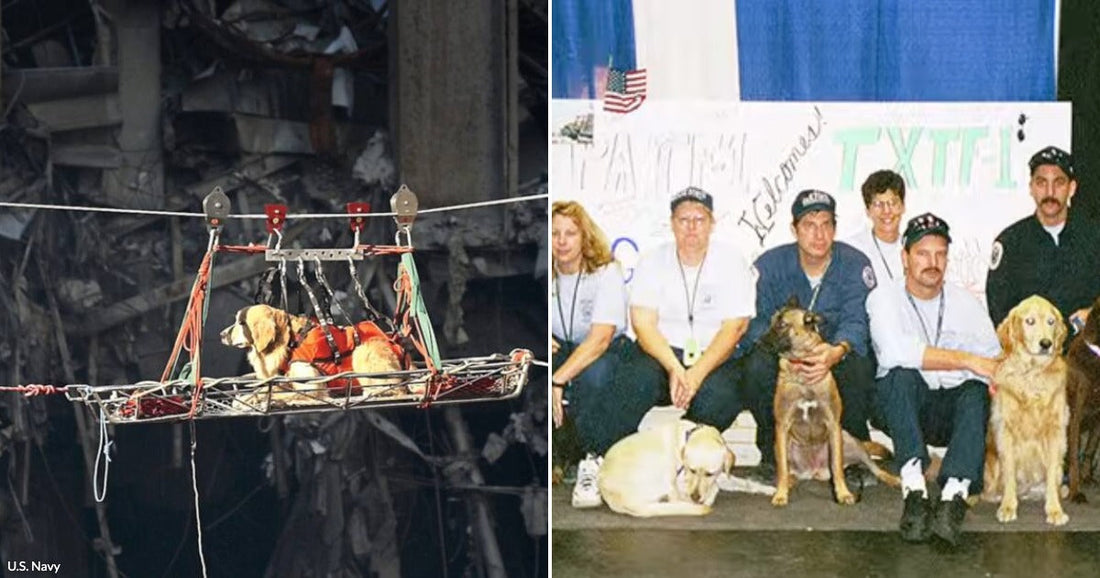
On September 11, 2001, as the world watched scenes of destruction unfold in New York and Washington, an extraordinary group of quiet heroes went to work alongside firefighters, police officers, and medics. These were the search and rescue dogs of 9/11, animals trained to move toward danger rather than away from it, and companion animals who simply refused to leave their people behind. Their stories bring a deeply human dimension to that terrible day and show how courage can appear in many forms, including four-legged ones.
Nearly 3,000 people were killed in the terror attacks on the World Trade Center and the Pentagon, and countless others were injured. Long after the planes struck and the towers fell, the devastation continued in the form of smoke, dust, twisted steel, and haunting silence. In that silence, rescue workers searched frantically for survivors. Working next to them were teams of specially trained dogs, some already seasoned in disaster zones and others embarking on their first major mission. Together, they combed the ruins, alert for the faintest sign of life and willing to push themselves to the edge of exhaustion.

Among the most remembered 9/11 rescue dogs was Bretagne, a two-year-old golden retriever whose deployment to ground zero was her very first experience in disaster work. Thrust into the chaos of collapsed buildings and unstable rubble, she learned her calling in real time. Handlers and observers later described how dogs like Bretagne navigated jagged debris and precarious surfaces to search for survivors. Their keen sense of smell became an essential tool in a place where traditional equipment often failed, and their presence alone could lift the morale of weary human responders.
In Washington, D.C., another dog carried out equally important work in the aftermath of the attack on the Pentagon. Sage, a border collie, was part of the team tasked with searching the wreckage there. Among the twisted remains, Sage located the body of a terrorist. In a scene marked by loss and chaos, that discovery formed part of the vital effort to understand exactly what had happened. It was a role that required the same steady focus and composure seen at ground zero in New York, and it underlined how broadly these canine teams contributed to the overall response.
Back in New York, a German Shepherd named Trakr became known for his remarkable talent in the shattered remains of the Twin Towers. Trakr was already an experienced police dog, and the account of his work among the rubble describes a dog with an extraordinary nose and an even more extraordinary drive to find people. His skill impressed observers so much that he was later cloned, a testament to how unique his abilities seemed to those who watched him move through one of the most challenging disaster sites in modern history.

YouTube/Penn Vet Working Dog Center
Another golden retriever, Riley, also worked among the ruins of the World Trade Center. The source notes that Riley took part in the difficult search for survivors, moving among debris that was not only physically hazardous but also emotionally overwhelming. Years later, Riley’s story was included in Mackenzie Lee’s 2019 book “The History of the World in Fifty Dogs,” which highlights how individual animals have intersected with pivotal moments in human history. Through that retelling, Riley’s efforts at ground zero became part of a broader reflection on the role of animals in times of crisis.
Jake, an American black lab, stands out for his extended record of service. The article describes him as a dog who not only proved himself in the aftermath of 9/11 but later responded to another major disaster, Hurricane Katrina. This detail shows that for some of these dogs, 9/11 was not an isolated chapter but part of a longer career in emergency response. Their work continued long after the dust settled in New York and Washington, following them into other devastated communities where people again looked to them for help.

YouTube/Penn Vet Working Dog Center
Not all of the canine heroes of that day had formal disaster training. Some were guide dogs whose primary role was to support their human partners under ordinary circumstances, yet they rose to the challenge when everything changed in an instant. Roselle, a guide dog for a blind man named Michael Hingson, became one of the most widely shared examples of this kind of bravery. After the first plane struck the World Trade Center, Roselle calmly led Hingson to safety, navigating smoke, confusion, and crowded stairwells. Her work represented a different side of the 9/11 dog stories, one where everyday service and trust suddenly became matters of life and death.
Another German Shepherd, Apollo, earned particular recognition as the first canine responder to arrive at ground zero. He worked alongside human crews in conditions that were extremely hazardous, with lingering smoke, unstable debris, and the constant risk of further collapse. The article notes that Apollo’s visibility in the media helped draw national attention to the role of all search and rescue dogs who served on 9/11. He would later appear at a ceremony to accept an award on behalf of every canine who took part in the response.

YouTube/Penn Vet Working Dog Center
The inscription associated with Apollo’s award captures the essence of what these animals did. It honors the dogs “for tireless courage in the service of humanity during the search and rescue operations in New York and Washington on and after 11 September 2001.” It also highlights their unwavering obedience and focus, stating that they remained “faithful to words of command and undaunted by the task.” The sentiment concludes by noting that their work and devotion stand as a testament to all who were lost or injured, recognizing that the dogs’ contributions are inseparable from the broader human story of that day.
In reflecting on these accounts, the source emphasizes that heroism is not confined to a uniform or even to two-legged responders. The loyalty and determination shown by Bretagne, Sage, Trakr, Riley, Jake, Roselle, Apollo, and many unnamed dogs reveal another dimension of courage during one of the darkest chapters in American history. They braved towering piles of debris, acrid smoke, and the emotional weight of a nation in mourning, simply because they were trained to help and trusted the handlers at their side.
The stories of the hero dogs of 9/11 continue to resonate because they illustrate how deeply interconnected people and animals can be, especially in moments of shared crisis. Search and rescue dogs brought specialized skills to ground zero and the Pentagon, yet they also brought something less tangible: comfort, companionship, and a reminder of compassion amid devastation. Their legacy is a powerful one. It suggests that in answering the call of duty, whether in structured search missions or in the instinctive protection of a guide dog leading someone to safety, these animals earned their place among the many who are remembered as heroes of that day.