
Doris Miller's Pearl Harbor Heroism Inspired Changes in the Navy
Guest Contributor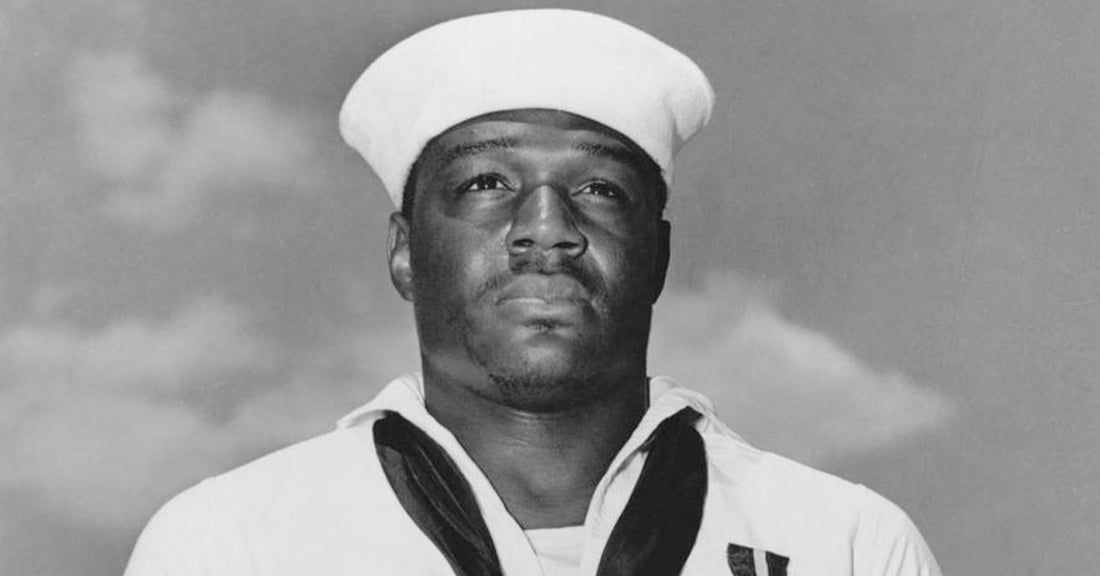
When the attack on Pearl Harbor erupted on December 7, 1941, a young African-American sailor named Doris Miller stepped into history. Though he had been relegated to kitchen duty due to the U.S. Navy's segregationist policies, Miller’s actions that day would make him one of the most recognized heroes of World War II. His story is a powerful reminder of courage in the face of injustice and how one individual can spark change, even without intending to.

Doris Miller, often called "Dorie" by friends and shipmates, was born on October 12, 1919, in Waco, Texas. He grew up in a working-class family and stood out early on for his athleticism, playing fullback on his high school football team. After graduating, he enlisted in the Navy in 1939, hoping to see the world and support his family. However, like all African-American sailors at the time, he was restricted to non-combat service roles. Assigned as a ship's cook, third class, Miller’s duties included shining officers’ shoes, making beds, and serving meals—tasks far from the battle stations he longed to man.
Despite these limitations, Miller quickly earned the respect of his peers. While stationed on the USS West Virginia, he became the ship’s heavyweight boxing champion, a title not easily won on a vessel with 2,000 men. His physical strength and determination were evident, but it would take a crisis for the full measure of his character to be revealed.
On the morning of the Japanese surprise attack on Pearl Harbor, Miller was below deck doing laundry when the call to general quarters rang out. He rushed to his assigned battle station at the antiaircraft battery magazine, only to find it had been destroyed by a torpedo. Undeterred, he leapt into action, first assisting in evacuating the wounded, including the ship’s mortally wounded captain, Mervyn Bennion. Then, without formal training, he took control of a .50 caliber anti-aircraft machine gun and began firing at incoming enemy planes.
“It wasn’t hard. I just pulled the trigger and she worked fine,” Miller later said. Though accounts differ on whether he shot down any planes, his bravery under fire and his willingness to take initiative in a life-or-death moment made a deep impression on those around him. After the attack, Miller continued aiding his fellow sailors, pulling survivors from the water as the West Virginia sank, taking 130 crew members with it.
Initially, Miller’s heroism went unrecognized. On December 15, 1941, the Navy issued a list of commendations that included only an “unnamed Negro.” It wasn’t until March 1942, following pressure from the NAACP and others, that Miller was formally acknowledged. On May 27, 1942, Admiral Chester Nimitz awarded him the Navy Cross aboard the USS Enterprise, making Miller the first African-American to receive the Navy’s second-highest honor for valor.
The citation praised Miller’s “distinguished devotion to duty, extraordinary courage and disregard of his personal safety.” Admiral Nimitz noted, “This marks the first time in this conflict that such high tribute has been made in the Pacific Fleet to a member of his race.” I found this detail striking—not only because of the honor itself, but because it signaled the beginning of a slow shift in military policy and public perception.
Tragically, Miller would not live to see the long-term impact of his actions. On November 24, 1943, he was aboard the USS Liscome Bay when it was struck by a Japanese torpedo near Butaritari Island. The ship sank quickly, taking two-thirds of its crew with it, including Miller. He was just 24 years old.
Yet Miller’s legacy endured. His bravery helped prompt the Navy to begin allowing African-Americans to serve in combat roles, a significant step toward desegregating the military. Some historians even consider his actions a precursor to the broader Civil Rights Movement. His story gained renewed attention in 2020 when the U.S. Navy announced that a new aircraft carrier would bear his name—the USS Doris Miller. It marked the first time an aircraft carrier was named after an African-American and a non-commissioned officer.
At the naming ceremony, held on Martin Luther King Jr. Day, Acting Navy Secretary Thomas B. Modly remarked, “As we celebrate the legacy of Martin Luther King Jr., we recognize that for too many of these warriors the liberty they defended overseas was denied to them and their families here at home simply because of the color of their skin.” The future USS Doris Miller, scheduled to launch in 2028, will be the most powerful warship ever constructed—a fitting tribute to a man who showed immense strength under fire.
Doris Miller’s story is one of resilience, bravery, and quiet determination. From the confines of a ship’s kitchen, he rose to become a symbol of heroism and a catalyst for change. His courage did not just save lives on that fateful day in Pearl Harbor; it also helped reshape the Navy and, in time, the nation’s understanding of equality and service.