
FDNY Chaplain Rushed Into the World Trade Center to Help and Became 9/11’s First Confirmed Victim
Matthew Russell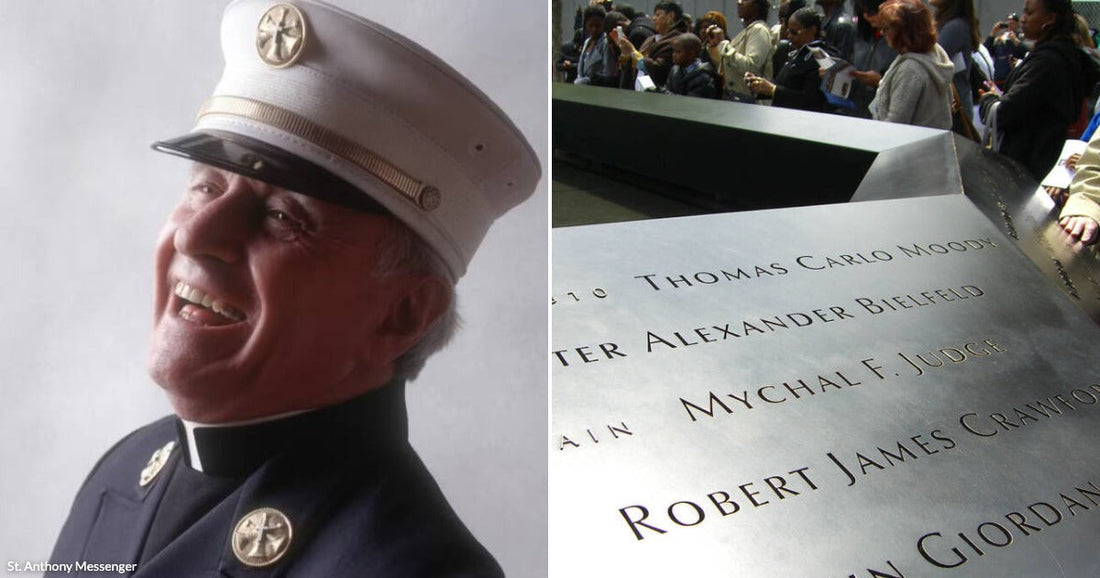
The story of Father Mychal Judge, the beloved New York City Fire Department chaplain and the first confirmed casualty of the September 11 attacks, is at once heartbreaking and deeply humane. In the middle of unimaginable chaos at the World Trade Center, he moved toward danger to pray, comfort, and stand alongside first responders. Remembering his life offers a human face to a day often told in numbers and timelines, and it keeps alive the memory of a man whose instinct was always to help.
Born in Brooklyn in 1933, Mychal Judge grew up in modest circumstances and spent part of his youth shining shoes in Manhattan. During those trips he often visited the friars at St. Francis of Assisi Church. Those quiet encounters stayed with him. As a teenager he took steps to become a Franciscan friar himself, beginning a life that would blend spiritual devotion with a very practical, on-the-street ministry. People who knew him would later recall that he seemed to seek out those who were hurting most, whether they were firefighters, people experiencing homelessness, or patients in the midst of the AIDS crisis.

St. Anthony Messenger
One early episode shows the kind of courage that would define Father Mychal Judge long before anyone called him a 9/11 hero. As a young Franciscan priest in East Rutherford, New Jersey, he responded to a volatile domestic crisis. An armed man had barricaded himself in the attic and was threatening to shoot his wife and baby. Instead of staying behind police lines, Judge climbed a ladder to reach the man. He wore his long brown robe and carried no weapon, only his willingness to listen and talk. Those waiting outside braced themselves for the sound of gunfire. After an agonizing stretch of time, the front door opened. The wife emerged carrying the baby, the armed man followed, and behind them walked Father Mychal with his arm around the man who had just been threatening his family.
Stories like this followed him throughout his ministry. In the 1980s he was assigned to St. Francis of Assisi Church in Manhattan, the same parish he had admired as a boy. There, amid the fear and stigma of the AIDS epidemic, he quietly spent time with patients, offering support when many others pulled away. He extended the same compassion to people living on the streets, those struggling with addiction, and anyone he encountered in crisis. His approach was simple but radical in practice. He showed up, listened, and stayed, whether the need was spiritual, emotional, or very practical.

In 1992 he became chaplain to the New York City Fire Department. Firefighters who served with him have described how easily he fit into firehouse life. He could drink coffee at the kitchen table, watch the ballgame, listen to gripes about the job, and then, when it came time to celebrate Mass, he seemed to transform. One firefighter remembered that at the moment of the Eucharist he became especially reverent, so focused that it felt as if something sacred entered even the most ordinary firehouse room. He was present after house fires and accidents, and he showed up after large-scale disasters such as the crash of TWA Flight 800 in 1996, always looking for those who needed reassurance, a blessing, or simply someone to stand beside them.
That pattern continued on the morning of Sept. 11, 2001. When news reached the Engine 1/Ladder 24 firehouse, located across the street from St. Francis of Assisi, that a plane had hit the World Trade Center North Tower, Mychal Judge did what he had done so many times before. He rushed to join firefighters heading downtown. The hijacked American Airlines Flight 11 had struck the North Tower at 8:46 a.m., and United Airlines Flight 175 hit the South Tower at 9:03 a.m., yet no one on the ground fully grasped that nearly 3,000 people would lose their lives that day, including hundreds of first responders. The focus was on rescue.

At the World Trade Center, the chaplain moved among those gathered at the base of the burning towers. He prayed for the dead and the dying, including individuals forced to jump from high floors to escape flames and smoke. A crew of documentary filmmakers, who had been following the fire department before the attacks, captured some of his final moments. Those who knew him later watched the footage and noticed his lips moving. They believed he was praying and offering absolution to people as they fell, continuing his ministry in the most desperate circumstances imaginable.
At 9:59 a.m., the South Tower collapsed. The 110-story structure fell with astonishing force, sending choking dust and violent debris crashing into the North Tower lobby where Father Mychal Judge had taken shelter with others. That blast of debris struck him and ended his life. He was 68 years old. An NYPD lieutenant, Bill Cosgrove, discovered his body in the lobby, shining a light across the devastated scene and recognizing the chaplain whom so many firefighters considered a friend.
Cosgrove and several others carried the priest’s body out of the North Tower and across the street, an image captured in a now well known Reuters photograph. Not long after, at 10:28 a.m., the North Tower itself collapsed. Cosgrove would later reflect that searching for and then carrying out the chaplain almost certainly saved his own life and the lives of the others in that group. If they had remained inside attempting to rescue additional people, they likely would have been caught in the collapse as were many firefighters and officers that day. In that sense, Father Mychal Judge, even in death, protected the people around him.
His body became the first to be formally released from Ground Zero, and his death certificate bore the number 1, leading many to refer to him as 9/11 victim 0001. In the days after the attacks, while fires still smoldered at the site of the fallen towers, about 3,000 people filled St. Francis of Assisi Church for his funeral. Friends, firefighters, city officials, and ordinary New Yorkers crowded into the parish associated with so many of his earlier acts of kindness.
His close friend Father Michael Duffy delivered the homily. He reflected on the meaning some found in the fact that Judge’s death certificate was the first issued after the attacks. Among the thousands who had perished, he suggested that perhaps there was a purpose in that numbering. As more names and bodies emerged from the rubble in the coming weeks, Duffy imagined Mychal Judge on the other side of death, greeting each person with his familiar Irish smile, taking them by the hand and saying, as a chaplain might say to anyone in need of comfort, that he wanted to bring them to his Father.
I found this image particularly striking because it connects the chaos of that day to the quiet, personal work that defined Judge’s whole life. He had spent decades entering rooms filled with fear, grief, or anger and staying with people who felt alone. Whether it was an armed domestic standoff in New Jersey, a hospital ward during the AIDS crisis, or the smoldering pile of Ground Zero, his response remained consistent. He showed up where suffering was greatest and tried, in the ways available to him, to ease it.
Remembering Father Mychal Judge as the first confirmed casualty of September 11 is important for the historical record, but it does not fully capture who he was. He was a Franciscan friar, a fire department chaplain, a familiar figure in Manhattan streets and firehouses, and a steady presence at scenes of tragedy long before the day the world learned his name. His story is one of quiet heroism, rooted in daily acts of service and brought into sharper relief by the events of 9/11. In telling it, people honor not only a single chaplain but also the many first responders and civilians whose lives were shaped by courage, compassion, and a willingness to step forward when others were forced to run away.