
Meet The Sweet Little Vampires Who Would Rather Nibble Grass Than Bite Necks
Matthew Russell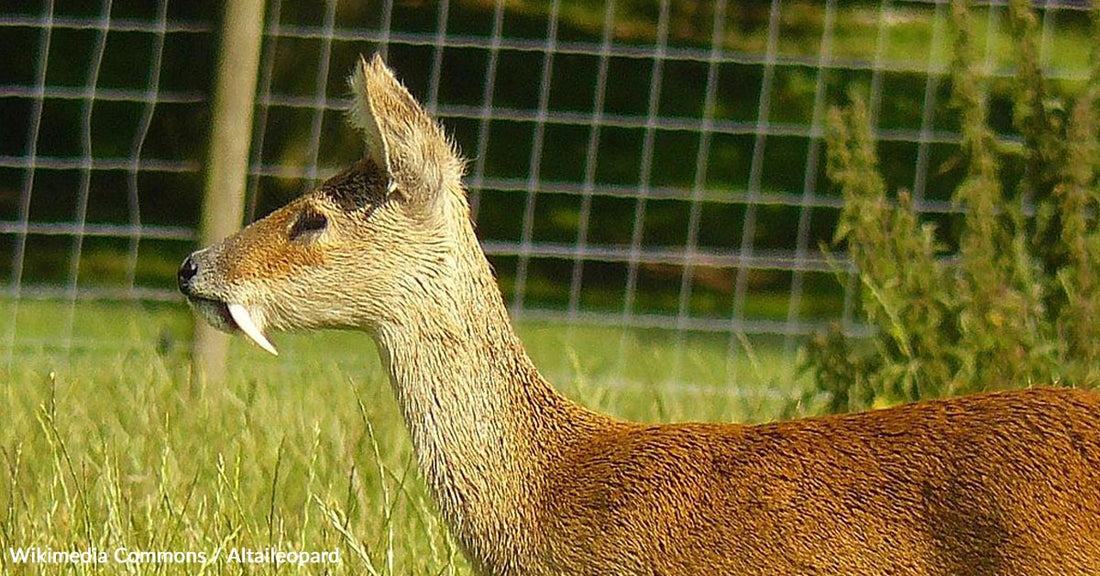

They look like a Halloween gag. They’re not. Several small Asian deer grow visible upper canines that jut like fangs.
The nickname “vampire deer” most often points to Chinese water deer, but it also fits musk deer, muntjacs, and tufted deer. Their teeth aren’t for drinking blood. They’re tools for display and duels.
As Zoo Atlanta’s Jen Webb told National Geographic, taller deer “grew larger antlers and lost the tusks, while smaller deer retained the tusks,” a split rooted in their shared ancestor

Photo: Wikimedia Commons / 丘崈, License: CC0 1.0
“Vampire deer” is a nickname for several small fanged deer.
Teeth Over Antlers
Chinese water deer lack antlers altogether. Males brandish curved canines that can reach about two inches and even hinge back a bit while grazing, independent deer researcher Arnold Cooke told National Geographic.
Musk deer show longer, saber-like tusks but also no antlers. Muntjacs carry both short antlers and small canines. In tight cover, tusks matter. They don’t snag like antlers.
Where They Live—and Why Some Are in Britain
Chinese water deer are native to China and Korea. They swim well, haunt reedbeds, and thrive as solitary browsers. In Korea they can damage crops. In Europe, free-ranging herds stem from escapes and early 20th-century releases; today, the U.K. population is estimated in the low thousands and is managed as an invasive species, IFLScience reports.
A longer backstory traces to the 1890s, when the Duke of Bedford imported Chinese water deer to England—an act that later helped preserve the species when Chinese numbers crashed, according to ZME Science.

Photo: Wikimedia Commons / Altaileopard, License: Public Domain
Chinese water deer lack antlers and grow visible upper canines.
How They Live
These deer are tiny. Chinese water deer stand about 20 inches at the shoulder and eat grasses and herbs, not flesh, IFLScience notes. Females may birth large litters—up to six fawns—but early mortality is high. About 40 percent can die in the first month, according to the British Deer Society.
The Price of Musk
Musk deer are ghosts of mountain forests from Afghanistan to Siberia. They’re secretive and scarce. Most of the seven species are endangered, driven by demand for the male’s musk gland—worth “as much as $45,000/kilo on the black market,” according to Wildlife Conservation Society figures reported by National Geographic.
The Siberian musk deer faces poaching and habitat loss but persists in rugged taiga across Russia, Mongolia, and China, with conservation pushes focused on habitat protection and stricter controls, Animals Around The Globe reports.
Misleading Name, Real Stakes
“Vampire” is a misleading name. The reality is a set of shy herbivores adapted to thick brush and waterlogged margins. Some populations stabilize or even expand where predators have vanished; others spiral under traps and trade.
The IUCN lists Chinese water deer as Vulnerable amid poaching and farmland conversion, IFLScience notes. The fangs catch our eye. The future of this species depends on what we do next.