
Scientists Stumble Upon the World's First New Wild Cat Species Discovered in More Than a Century
Matthew Russell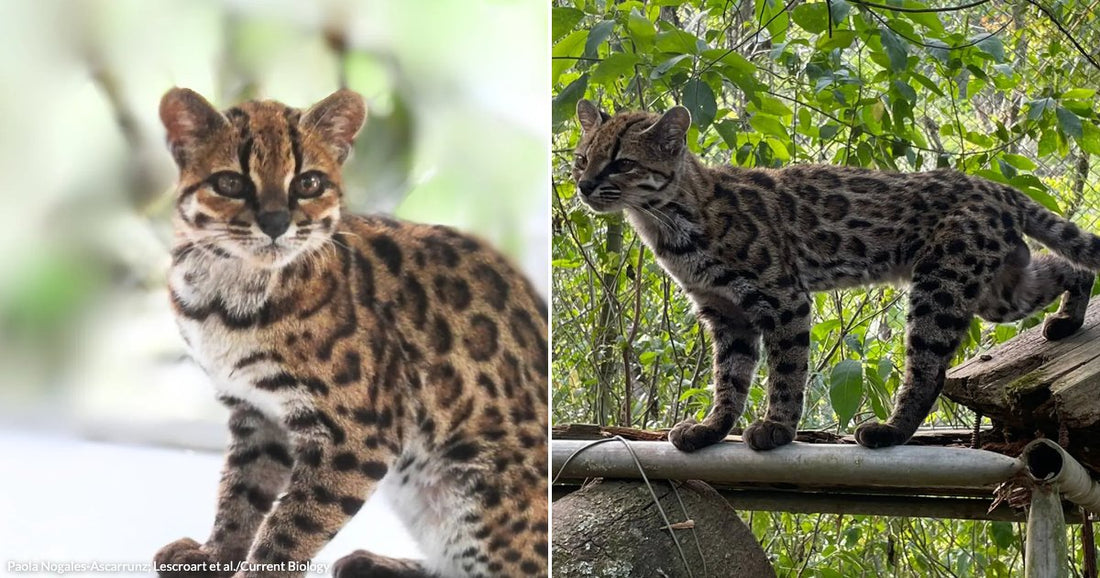
A local man in Bolivia found a tiny spotted kitten near the edge of a forest and brought it home. He fed it noodles, rice, and eggs. After about a year living with a clearly wild animal, he realized it belonged somewhere else — and surrendered it to a wildlife sanctuary. That small act of surrender set off a chain of events that would rewrite the cat family tree.
National Geographic reports that in 2016, biologist Paola Nogales-Ascarrunz received a call from the Senda Verde Wildlife Sanctuary in Bolivia about a cat that staff described as simply "weird." She went to see it for herself and was immediately transfixed.
"I saw this cat. It was really, really small, and I couldn't believe how small it was," Nogales-Ascarrunz told NBC News. She took a hundred photographs. She could not stop looking at it.

A Century-Making Discovery
The animal she was staring at — spotted like a leopard, slender, with a scrunched-up face and rounded ears — is now formally known as Leopardus tilcayo, the tilcayo tiger cat. Live Science reports that the species, described in the journal Current Biology, is the first novel living cat species to be formally named in over a century.
Scientific American notes the finding is not a reclassification of something previously known — it is entirely new to science, something far rarer and more significant than a taxonomic reshuffling.
"This time, it's a cat. That's really novel. And it hasn't happened in 100 years," Nogales-Ascarrunz said, per NBC News.

What the Genome Revealed
Suspicion alone was not enough. It took years of painstaking genetic work before the tilcayo's secret was confirmed. Working with geneticist Eduardo Eizirik and evolutionary biologist Jonas Lescroart of the University of Antwerp, the team sequenced complete genomes from 38 individual cats spanning South and Central America, including eight samples drawn from museum specimens, Live Science reports.
The results were unambiguous. National Geographic reports that the tilcayo had diverged from its closest relatives roughly 1.4 million years ago — an evolutionary gap comparable to the distance between modern lions and the extinct cave lion. The broader analysis confirmed five distinct tiger cat species in South America, not the two that had long been officially recognized.
The study also named a previously unknown subspecies in Peru, Leopardus tigrinus antisuyo, a nod to Antisuyu — the region of the ancient Inca Empire that covered its habitat — GB News reports.

Named by the People Who Always Knew
The cat's scientific name preserves the word local Bolivian communities have used for it across generations: tilcayo. When researchers asked locals why they called it that, the answer was simple — they did not know. The name had simply always existed, National Geographic notes.
Nogales-Ascarrunz, a National Geographic Explorer herself and a native of Bolivia, said the naming felt right. The science had finally caught up with something her country's communities already understood.
A Beautiful Animal in a Vanishing World
The tilcayo is smaller than a typical house cat, weighing roughly three pounds and measuring around 18 inches from head to body, CP24 reports. It has a muted brown coat marked by large dark rosettes, rounded ears, and a long, slender tail. Camera-trap records suggest it may be nocturnal; rodent remains in scat point to its likely diet, according to The Peninsula Qatar.
Its home — the Bolivian Yungas, where the Andes descend into the Amazon basin — ranks among South America's most threatened ecosystems, facing deforestation, agricultural expansion, fires, and mining pressure. GB News reports that the IUCN is expected to evaluate all five tiger cat lineages independently, and the tilcayo could potentially qualify for an endangered classification when assessed on its own.
"All of them are in habitats that are vanishing fast," co-author Tadeu de Oliveira, an ecologist at the State University of Maranhão in Brazil, told NBC News.
Nogales-Ascarrunz is now deploying camera traps across the Yungas to map how many tilcayos are left and where they live. The world has only just learned this animal's name. The race to protect it has already begun.