
Americas Oceans Are Growing More Acidic and Federal Monitoring Cannot Keep Up
Matthew Russell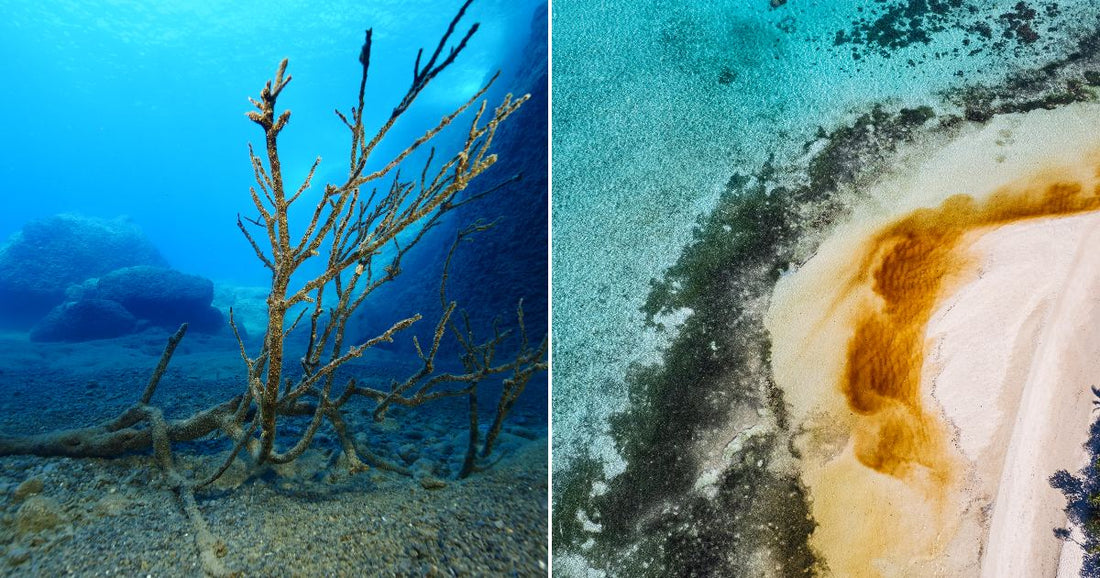
Carbon dioxide doesn't just warm the atmosphere. When it dissolves into seawater, it triggers a chemical reaction that makes the ocean more acidic. Since the Industrial Revolution, ocean pH has dropped by about 0.1 units — a figure that sounds small but represents roughly a 26% increase in acidity. According to Scientific American, this shift has already pushed Earth past one of its defined planetary boundaries — the thresholds scientists use to measure whether the planet remains in a stable, habitable state.
That's not a projection. It's where we are now.

When carbon dioxide dissolves into seawater, it triggers a chemical reaction that increases the ocean's acidity.
What's at Stake for Marine Life
The consequences ripple through the entire food web. More acidic water disrupts the ability of oysters, clams, mussels, sea urchins, and corals to build and maintain their shells and skeletons, which depend on calcium carbonate. As Phys.org reports, the scale and speed of today's acidification is extraordinary even by geological standards — the oceans are absorbing carbon dioxide faster than at almost any point in Earth's recorded deep-time history.
For coral reefs, the damage compounds existing threats like warming and bleaching. For shellfish industries — already a multi-billion-dollar sector along American coasts — the chemistry is an existential threat. Hatcheries in the Pacific Northwest have documented larvae die-offs tied directly to acidified water. The economic and ecological costs extend far beyond seafood; entire coastal communities depend on these ecosystems.

More acidic seawater disrupts the ability of oysters, clams, mussels, sea urchins, and corals to form and maintain their calcium carbonate shells and skeletons.
Why Monitoring Matters Now
You can't manage what you can't measure. Right now, the United States has significant gaps in its understanding of how acidification is playing out differently across its coastlines. The Atlantic and Pacific behave differently. So do deep waters versus surface waters, and open ocean versus near-shore areas where runoff and nutrient pollution add their own chemical stress.
This summer, NOAA took a meaningful step. The agency launched simultaneous research cruises along both the East and West Coasts — the first time it has conducted coordinated, coastwide surveys on both seaboards at once, according to the NOAA Ocean Acidification Program. The West Coast mission, detailed by the NOAA Pacific Marine Environmental Laboratory, is collecting water chemistry data across hundreds of stations to build a clearer picture of where conditions are most severe and how they're trending over time.
These surveys are exactly the kind of sustained, systematic science that allows resource managers, fishing industries, and policymakers to make informed decisions. The challenge is that one-time or infrequent surveys have limited value. Ocean chemistry fluctuates seasonally, annually, and in response to events like El Niño. Long-term monitoring networks — maintained year after year — are what reveal the true trajectory.

Near-shore ocean areas face compounded chemical stress from both acidification and nutrient runoff from land.
The Gap Between Science and Action
The science is clear. The monitoring infrastructure, however, remains underfunded relative to the scope of the problem. Expanding permanent monitoring networks along every major coastline, funding the research needed to understand regional variations, and equipping managers with real-time data — all of this requires sustained federal investment.
America's fisheries, reefs, and coastal economies can't wait for the data gaps to close on their own. Asking NOAA to prioritize and expand this work is one direct, practical way to respond to a documented and accelerating threat.
Click below to make a difference.